


Page 163 - AJWEP-22-6
P. 163
Water quality of Bharatpur, Nepal

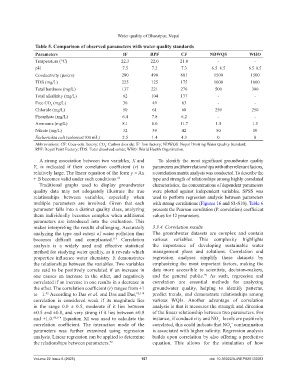
                 Table 5. Comparison of observed parameters with water quality standards
                 Parameters                            IF          RPF           CF          NDWQS             WHO
                 Temperature (°C)                     22.3         22.0         21.8             -               -
                 pH                                    7.5          7.2          7.3          6.5–8.5          6.5–8.5
                 Conductivity (µs/cm)                  280          490          601           1500            1500
                 TDS (mg/L)                            225          125          175           1000            1000
                 Total hardness (mg/L)                 137          221          276            500             300
                 Total alkalinity (mg/L)               62           104          137             -               -
                 Free CO  (mg/L)                       36           49           63              -               -
                       2
                 Chloride (mg/L)                       50           61           68             250             250
                 Phosphate (mg/L)                      6.4          7.8          6.2             -               -
                 Ammonia (mg/L)                        8.1          8.0         11.7            1.5             1.5
                 Nitrate (mg/L)                        32           39           42             50              10
                 Escherichia coli (colonies/100 mL)    2.5          1.4          4.3             0               0
                 Abbreviations: CF: Coca-cola factory; CO : Carbon dioxide; IF: Iron factory; NDWQS: Nepal Drinking Water Quality Standard;
                                               2
                 RPF: Royal Paint Factory; TDS: Total dissolved solids; WHO: World Health Organization.
                  A strong association between two variables, X and    To  identify  the  most  significant  groundwater  quality
                Y,  is  indicated  if  their  correlation  coefficient  (r) is   parameters and their relationships with other relevant factors,
                relatively large. The linear equation of the form y = Ax   a correlation matrix analysis was conducted. To describe the
                + B becomes valid under such conditions. 66         type and strength of relationships among highly correlated
                  Traditional  graphs used to display groundwater   characteristics, the concentrations of dependent parameters
                quality data may not adequately illustrate the true   were plotted against independent variables. SPSS was
                relationships between variables, especially when    used to perform regression analysis between parameters
                multiple parameters are involved. Given that each   with strong correlations (Figures 16 and S1-S10). Table 6
                parameter falls into a distinct quality class, analyzing   presents the Pearson correlation (P. correlation) coefficient
                them individually becomes complex when additional   values for 12 parameters.
                parameters are introduced into the evaluation.  This
                makes interpreting the results challenging. Accurately   3.3.4. Correlation results
                analyzing the type and extent of water pollution thus   The groundwater datasets are complex and contain
                becomes  difficult  and  complicated.  Correlation   various variables.  This complexity highlights
                                                   113
                analysis  is  a  widely  used  and  effective  statistical   the importance of developing sustainable water
                method for studying water quality, as it reveals which   management  plans  and  solutions.  Correlation  and
                properties  influence  water  chemistry.  It  demonstrates   regression analyses simplify these datasets by
                the relationships between the variables. Two variables   emphasizing the most important factors, making the
                are said to be positively correlated if an  increase in   data more accessible to scientists, decision-makers,
                                                                                           96
                one causes an increase in the other, and negatively   and the general public.   As such, regression and
                correlated if an increase in one results in a decrease in   correlation are essential methods for analyzing
                the other. The correlation coefficient (r) ranges from +1   groundwater quality, helping to identify patterns,
                to −1.  According to Das et al. and Das and Das, 92,114    predict  trends,  and  demonstrate  relationships among
                     92
                correlation is considered weak if its magnitude lies   various  WQIs.  Another advantage of correlation
                in  the  range  0.0  ±  0.5,  moderate  if  it  lies  between   analysis is that it measures the strength and direction
                ±0.5 and ±0.8, and very strong if it lies between ±0.8   of the linear relationship between two parameters. For
                and ±1.0. 66,114  Equation XI was used to calculate the   instance, if conductivity and NO  levels are positively
                                                                                                  −
                                                                                                 3
                correlation  coefficient.  The  interaction  mode  of  the   correlated, this could indicate that NO  contamination
                                                                                                       −
                                                                                                      3
                parameters was further examined using regression    is associated with higher salinity. Regression analysis
                analysis. Linear regression can be applied to determine   builds upon correlation by also offering a predictive
                the relationships between parameters. 92            equation.  This allows for the simulation of how


                Volume 22 Issue 6 (2025)                       157                           doi: 10.36922/AJWEP025120083

