


Page 206 - AJWEP-22-6
P. 206
Gerson, et al.

                which  operate  in  parallel  to  allow  flexible  hydraulic   2.2. Methods
                distribution and enhance treatment performance under   2.2.1. Sampling strategy
                variable loading conditions. This configuration enables   To evaluate  the stage-wise and overall  performance
                the ponds to accommodate fluctuating industrial flows   of  the  Kalobe  WSP  system,  a  structured  sampling
                by distributing influent across multiple units rather than   strategy was developed to assess influent and effluent
                operating strictly in series.                       quality  across each  treatment  stage.  Composite  grab
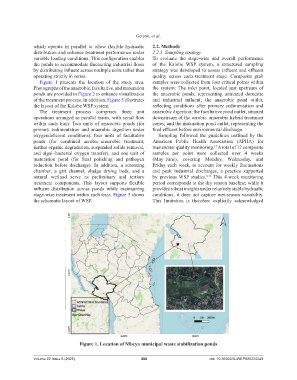
                  Figure  1 presents the  location  of the  study area.   samples were collected from four critical points within
                Photographs of the anaerobic, facultative, and maturation   the system:  The inlet point, located just upstream of
                ponds are provided in Figure 2 to enhance visualization   the anaerobic  ponds, representing untreated  domestic
                of the treatment process. In addition, Figure 3 illustrates   and  industrial  influent;  the  anaerobic  pond  outlet,
                the layout of the Kalobe WSP system.                reflecting  conditions  after  primary  sedimentation  and
                  The treatment  process comprises three unit       anaerobic digestion; the facultative pond outlet, situated
                operations arranged as parallel trains, with serial flow   downstream of the aerobic–anaerobic hybrid treatment
                within each  train:  Two units of anaerobic  ponds (for   zones; and the maturation pond outlet, representing the
                primary sedimentation  and anaerobic digestion under   final effluent before environmental discharge.
                oxygendeficient  conditions),  four  units  of  facultative   Sampling  followed  the  guidelines  outlined  by the
                ponds  (for  combined  aerobic–anaerobic  treatment,   American Public Health  Association (APHA)  for
                further organic degradation, suspended solids removal,   wastewater quality monitoring.  A total of 12 composite
                                                                                               17
                and  algal–bacterial  oxygen  transfer),  and  one  unit  of   samples  per  point  were  collected  over  4  weeks
                maturation  pond  (for  final  polishing  and  pathogen   (May–June),  covering  Monday,  Wednesday,  and
                reduction  before discharge). In addition,  a screening   Friday each week, to account for weekly fluctuations
                chamber, a grit  channel,  sludge drying beds, and a   and  peak  industrial  discharges, a  practice  supported
                natural  wetland  serve as preliminary  and tertiary   by previous  WSP studies. 6,16   This 4-week monitoring
                treatment  components.  This  layout  supports  flexible   period corresponds to the dry season baseline; while it
                influent  distribution  across  ponds  while  maintaining   provides robust insights under relatively stable hydraulic
                stage-wise treatment within each train. Figure 3 shows   conditions, it does not capture wet-season variability.
                the schematic layout of WSP.                        This  limitation  is  therefore  explicitly  acknowledged


                                    Figure 1. Location of Mbeya municipal waste stabilization ponds


                Volume 22 Issue 6 (2025)                       200                           doi: 10.36922/AJWEP025320249

