


Page 209 - AJWEP-22-6
P. 209
Performance of Kalobe waste ponds, Mbeya

                2.4. WSP treatment efficiency evaluation            are presented in the results section to visually support
                The  evaluation  of  treatment  performance  at  Kalobe   the stage-wise trends.
                WSPs  was conducted by analyzing  the removal
                efficiencies  of  six  selected  parameters  (BOD,  COD,   2.4.4. Pollutant load contribution
                TSS, ammonia, nitrite, and TDS) across the three major   Pollutant load (kg/day) for each parameter was computed
                units: Anaerobic, facultative, and maturation ponds.  using the standard mass loading equation (Equation I).
                                                                       The  contribution  (%)  of  each  industry  to  total
                2.4.1. Efficiency calculation method                pollutant loading was then derived by comparing each
                The  treatment  efficiency  for  each  parameter  at  each   load  to  the  total  system  load  for  BOD ,  COD, TSS,
                                                                                                        5
                stage was calculated  using the conventional  removal   ammonia, nitrite, and TDS.
                efficiency formula:                                    This analysis enabled the identification of industries
                                                                    that are primary contributors to organic, solids, and
                                        cin-cout
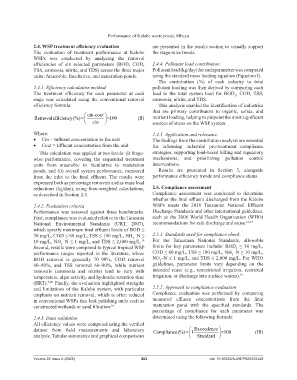
                Removalefficiency(%)=          ×100         (II)  nutrient loading, helping to pinpoint the most significant
                                         cin                      sources of stress on the WSP system.

                Where:                                              2.4.5. Application and relevance
                •  Cin = Influent concentration to the unit         The findings from the contribution analysis are essential
                •  Cout = Effluent concentration from the unit      for informing industrial pre-treatment  compliance
                  This calculation was applied at two levels: (i) Stage-  strategies, supporting load-based billing and regulatory
                wise performance,  covering the sequential  treatment   mechanisms,  and  prioritizing  pollution  control
                units from anaerobic  to facultative  to maturation   interventions.
                ponds, and (ii) overall system performance, measured   Results are presented  in Section  3, alongside
                from  the  inlet  to  the  final  effluent.  The  results  were   performance efficiency trends and compliance status.
                expressed both as percentage removals and as mass load
                reductions (kg/day), using flow-weighted calculations,   2.5. Compliance assessment
                as described in Section 2.5.                        Compliance  assessment was conducted  to determine
                                                                    whether the final effluent discharged from the Kalobe
                2.4.2. Evaluation criteria                          WSPs  meets  the  2018  Tanzanian  National  Effluent
                Performance was assessed against three benchmarks.   Discharge Standards and other international guidelines,
                First, compliance was evaluated relative to the Tanzania   such as the 2006 World Health  Organization  (WHO)
                National Environmental  Standards (URT, 2007),      recommendations for safe discharge and reuse. 19,14
                which specify maximum final effluent limits of BOD ≤
                30 mg/L, COD ≤ 60 mg/L, TSS ≤ 100 mg/L, NH –N ≤     2.5.1. Standards used for compliance check
                                                           3
                10 mg/L, NO –N ≤ 1 mg/L, and TDS ≤ 2,000 mg/L.      For the  Tanzanian  National  Standards, allowable
                                                               19
                            2
                Second, results were compared to typical tropical WSP   limits  for  key  parameters  include:  BOD   ≤  30  mg/L,
                                                                                                         5
                performance ranges reported in the literature,  where   COD ≤ 60 mg/L, TSS ≤ 100 mg/L, NH –N ≤ 10 mg/L,
                                                                                                       3
                BOD  removal  is  generally  70–90%,  COD  removal   NO –N ≤ 1 mg/L, and TDS ≤ 2,000 mg/L. For WHO
                                                                       2
                60–80%,  and  TSS  removal  60–90%,  while  nutrient   guidelines,  parameter  limits  vary depending  on the
                removals  (ammonia  and  nitrite)  tend  to  vary  with   intended  reuse (e.g., unrestricted  irrigation,  restricted
                temperature, algal activity, and hydraulic retention time   irrigation, or discharge into surface waters). 19
                (HRT). 7,20  Finally, the evaluation highlighted strengths
                and  limitations  of  the  Kalobe  system,  with  particular   2.5.2. Approach to compliance evaluation
                emphasis on nutrient removal, which is often reduced   Compliance  evaluation  was performed  by  comparing
                in conventional WSPs that lack polishing units such as   measured  effluent  concentrations  from  the  final
                constructed wetlands or sand filtration. 18         maturation  pond  with  the  specified  standards.  The
                                                                    percentage  of  compliance  for  each  parameter  was
                2.4.3. Data validation                              determined using the following formula:
                All efficiency values were computed using the verified

                dataset  from  field  measurements  and  laboratory   Compliance(%)=1  Exceedence  ×100         (III)
                analysis. Tabular summaries and graphical comparisons                  Standard


                Volume 22 Issue 6 (2025)                       203                           doi: 10.36922/AJWEP025320249

