


Page 219 - AJWEP-22-6
P. 219
Assessment of the surface urban heat island
defining the administrative boundaries of HCMC were 0.979 0.035− Red NDVI < NDVI Min
obtained from local government sources and used to ε = 0.986 0.004P NDVI+ ≤ NDVI≤ NDVI
delineate the study area. V Min Max
0.99 NDVI > NDVI Max
2.3. Data processing and analysis (II)
13
All image processing was conducted using established where P is determined from the following formula :
v
remote sensing algorithms listed below. The overall 2
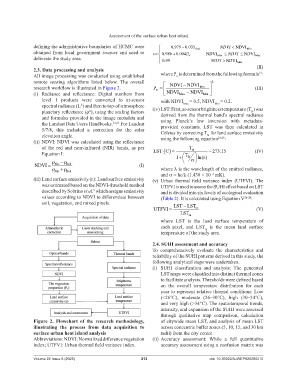
research workflow is illustrated in Figure 2. P NDVI NDVI Min (III)
V
(i) Radiance and reflectance: Digital numbers from NDVI Max NDVI Min
level 1 products were converted to at-sensor with NDVI = 0.5, NDVI = 0.2.
Min
Max
spectral radiance (L ) and then to top-of-atmosphere (iv) LST: First, at-sensor brightness temperature (T ) was
λ
planetary reflectance (ρ ), using the scaling factors derived from the thermal band’s spectral radiance
λ
B
and formulas provided in the image metadata and using Planck’s law inversion with metadata-
the Landsat Data Users Handbooks. 22,23 For Landsat provided constants. LST was then calculated in
5/7/8, this included a correction for the solar Celsius by correcting T for land surface emissivity
elevation angle. using the following equation 24,25 :
B
(ii) NDVI: NDVI was calculated using the reflectance
of the red and near-infrared (NIR) bands, as per T B
Equation I: LSTC T 273 15. (IV)
1 B α ln ε()
ρ ρ
NDVI Nir Red (I)
ρ ρ where λ is the wavelength of the emitted radiance,
Nir Red
and α = hc/k (1.438 × 10 mK).
−2
(iii) Land surface emissivity (ε): Land surface emissivity (v) Urban thermal field variance index (UTFVI): The
was estimated based on the NDVI-threshold method UTFVI is used to assess the SUHI effect based on LST
described by Sobrino et al. which assigns emissivity and is divided into six levels of ecological evaluation
9
values according to NDVI to differentiate between (Table 2). It is calculated using Equation V 26-28 :
soil, vegetation, and mixed pixels.
UTFVI LSTLST m (V)
LST
m
where LST is the land surface temperature of
each pixel, and LST is the mean land surface
m
temperature of the study area.
2.4. SUHI assessment and accuracy
To comprehensively evaluate the characteristics and
reliability of the SUHI patterns derived in this study, the
following analytical steps were undertaken.
(i) SUHI classification and analysis: The generated
LST maps were classified into distinct thermal zones
to facilitate analysis. Thresholds were defined based
on the overall temperature distribution for each
year to represent relative thermal conditions: Low
(<26°C), moderate (26–30°C), high (30–34°C),
and very high (>34°C). The spatiotemporal trends,
intensity, and expansion of the SUHI were assessed
through qualitative map comparison, calculation
Figure 2. Flowchart of the research methodology, of citywide mean LST, and analysis of mean LST
illustrating the process from data acquisition to across concentric buffer zones (5, 10, 15, and 30 km
surface urban heat island analysis radii) from the city center.
Abbreviations: NDVI: Normalized difference vegetation (ii) Accuracy assessment: While a full quantitative
index; UTFVI: Urban thermal field variance index. accuracy assessment using a confusion matrix was
Volume 22 Issue 6 (2025) 213 doi: 10.36922/AJWEP025260210

