


Page 223 - AJWEP-22-6
P. 223
Assessment of the surface urban heat island

                This empirically validates the crucial role of vegetation   strongly  absorb solar  radiation.  In contrast,  CLUHI
                                                                                                 2
                in mitigating  urban heat through evapotranspirational   is often most intense  at  night,  as urban areas  release
                cooling  and  shading  effects. 24,30   This  finding  has   stored heat more slowly than rural surroundings
                significant implications for urban planning in HCMC   (Table 5). Our study focuses on SUHI, which provides
                (Table 2). As the city continues to grow, the preservation   a spatially comprehensive view of how different land
                and strategic integration of green infrastructure—such   use types affect the surface energy balance, which is the
                as parks, green roofs, urban forests, and vegetated   fundamental driver of the entire UHI phenomenon.
                corridors—becomes paramount for thermal regulation
                and for improving urban comfort and resilience. 31  4.4. Implications for urban planning and public
                                                                    health
                4.3. SUHI versus canopy layer UHI (CLUHI)           The intensification of the SUHI in HCMC has several
                It  is important  to  distinguish  between  the  SUHI,   potential  adverse consequences.  These include
                measured  by satellite-derived LST, and  the  CLUHI,   increased energy demand for cooling, which can strain
                measured by in situ air temperature at weather stations.   energy  infrastructure  and  exacerbate  greenhouse  gas
                SUHI reflects the temperature of surfaces (e.g., roads,   emissions ;  a  heightened  risk  of  heat-related  health
                                                                             32
                rooftops), whereas CLUHI reflects the temperature of   problems for urban residents, such as heat stress and heat
                the air that people experience. SUHI typically exhibits   stroke ; and negative impacts on local ecosystems and
                                                                          33
                a much greater thermal  amplitude than CLUHI, with   air quality.  The expansion of the SUHI into suburban
                                                                              24
                peak intensity during the daytime when urban surfaces   areas suggests that these previously less-affected regions


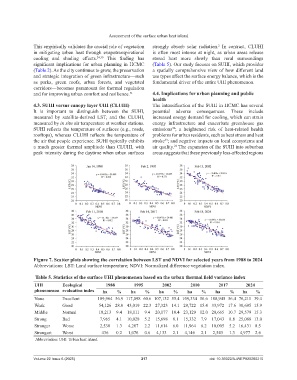
                Figure 7. Scatter plots showing the correlation between LST and NDVI for selected years from 1988 to 2024
                Abbreviations: LST: Land surface temperature; NDVI: Normalized difference vegetation index.

                 Table 5. Statistics of the surface UHI phenomenon based on the urban thermal field variance index
                UHI          Ecological         1988        1995        2002         2010        2017        2024
                phenomenon evaluation index   ha    %      ha    %     ha    %     ha     %     ha    %     ha    %
                None         Excellent      109,964 56.9 117,098 60.6 107,132 55.4 109,334 56.6 108,945 56.4 76,211 39.4
                Weak         Good            54,126 28.0 43,019 22.3 27,323 14.1 29,722 15.4 33,972 17.6 30,695 15.9
                Middle       Normal          18,213  9.4  18,111  9.4  20,177 10.4 23,129 12.0 20,665 10.7 29,579 15.3
                Strong       Bad             7,965  4.1  10,028  5.2  15,698  8.1  15,332  7.9  17,043  8.8 25,088 13.0
                Stronger     Worse           2,530  1.3  4,207   2.2  11,614  6.0  11,964  6.2  10,005  5.2 16,431 8.5
                Strongest    Worst            436   0.2  1,076   0.6  4,133  2.1  4,146   2.1  2,543  1.3  4,977  2.6
                 Abbreviation: UHI: Urban heat island.


                Volume 22 Issue 6 (2025)                       217                           doi: 10.36922/AJWEP025260210

