


Page 220 - AJWEP-22-6
P. 220
Hao

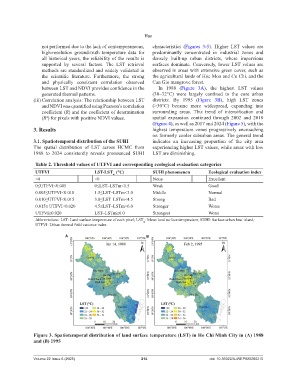
                   not performed due to the lack of contemporaneous,   characteristics  (Figures  3-5). Higher LST values  are
                   high-resolution  ground-truth  temperature  data  for   predominantly  concentrated  in industrial  zones and
                   all historical years, the reliability of the results is   densely  built-up urban districts,  where impervious
                   supported by several  factors.  The  LST retrieval   surfaces dominate. Conversely, lower LST values are
                   methods are standardized and widely validated in   observed in areas with extensive green cover, such as
                   the  scientific  literature.  Furthermore,  the  strong   the agricultural lands of Hoc Mon and Cu Chi, and the
                   and physically  consistent  correlation  observed   Can Gio mangrove forest.
                   between LST and NDVI provides confidence in the     In 1988 (Figure  3A), the highest LST values
                   generated thermal patterns.                      (30–32°C)  were  largely  confined  to  the  core  urban
                (iii) Correlation analysis: The relationship between LST   districts. By 1995 (Figure  3B),  high  LST  zones
                   and NDVI was quantified using Pearson’s correlation   (>30°C)  became  more  widespread,  expanding  into
                   coefficient (R) and the coefficient of determination   surrounding  areas.  This  trend  of  intensification  and
                   (R ) for pixels with positive NDVI values.       spatial  expansion  continued  through  2002  and  2010
                     2
                                                                    (Figure 4), as well as 2017 and 2024 (Figure 5), with the
                3. Results                                          highest temperature zones progressively encroaching
                                                                    on formerly cooler suburban areas. The general trend
                3.1. Spatiotemporal distribution of the SUHI        indicates an increasing proportion of the city area
                The  spatial  distribution  of LST across HCMC from   experiencing higher LST values, while areas with low
                1988 to 2024 consistently  reveals  pronounced SUHI   LST are diminishing.

                 Table 2. Threshold values of UTFVI and corresponding ecological evaluation categories
                 UTFVI                     LST-LST  (°C)            SUHI phenomenon          Ecological evaluation index
                                                   m
                 <0                        <0                       None                     Excellent
                 0≤UTFVI<0.005             0≤LST–LSTm<1.5           Weak                     Good
                 0.005≤UTFVI<0.010         1.5≤LST–LSTm<3.0         Middle                   Normal
                 0.010≤UTFVI<0.015         3.0≤LST–LSTm<4.5         Strong                   Bad
                 0.015≤ UTFVI<0.020        4.5≤LST–LSTm<6.0         Stronger                 Worse
                 UTFVI≥0.020               LST–LSTm≥6.0             Strongest                Worst
                 Abbreviations: LST: Land surface temperature of each pixel; LST : Mean land surface temperature; SUHI: Surface urban heat island;
                                                                m
                 UTFVI: Urban thermal field variance index.
                              A                                  B


                Figure 3. Spatiotemporal distribution of land surface temperature (LST) in Ho Chi Minh City in (A) 1988
                and (B) 1995


                Volume 22 Issue 6 (2025)                       214                           doi: 10.36922/AJWEP025260210

