


Page 221 - AJWEP-22-6
P. 221
Assessment of the surface urban heat island

                              A                                   B


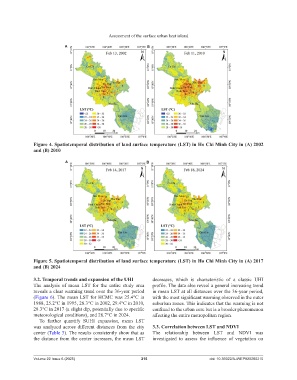
                Figure 4. Spatiotemporal distribution of land surface temperature (LST) in Ho Chi Minh City in (A) 2002
                and (B) 2010


                              A                                   B


                Figure 5. Spatiotemporal distribution of land surface temperature (LST) in Ho Chi Minh City in (A) 2017
                and (B) 2024


                3.2. Temporal trends and expansion of the UHI       decreases,  which  is  characteristic  of  a  classic  UHI
                The analysis of mean LST for the entire  study area   profile. The data also reveal a general increasing trend
                reveals a clear warming trend over the 36-year period   in mean LST at all distances over the 36-year period,
                (Figure 6). The mean LST for HCMC was 25.4°C in     with the most significant warming observed in the outer
                1988, 25.2°C in 1995, 28.3°C in 2002, 29.4°C in 2010,   suburban zones. This indicates that the warming is not
                28.3°C in 2017 (a slight dip, potentially due to specific   confined to the urban core but is a broader phenomenon
                meteorological conditions), and 28.7°C in 2024.     affecting the entire metropolitan region.
                  To  further  quantify  SUHI  expansion,  mean  LST
                was  analyzed  across  different  distances  from  the  city   3.3. Correlation between LST and NDVI
                center (Table 3). The results consistently show that as   The relationship between LST and NDVI  was
                the distance from the center increases, the mean LST   investigated  to  assess  the  influence  of  vegetation  on


                Volume 22 Issue 6 (2025)                       215                           doi: 10.36922/AJWEP025260210

