


Page 222 - AJWEP-22-6
P. 222
Hao


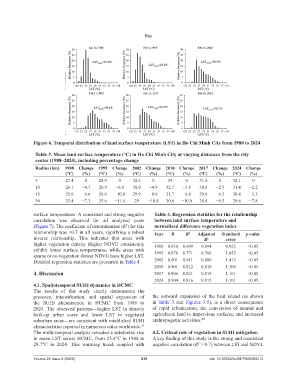
                Figure 6. Temporal distribution of land surface temperature (LST) in Ho Chi Minh City from 1988 to 2024

                 Table 3. Mean land surface temperature (°C) in Ho Chi Minh City at varying distances from the city
                 center (1988–2024), including percentage change
                 Radius (km)  1988  Change  1995  Change  2002  Change  2010  Change  2017  Change  2024  Change
                              (°C)   (%)     (°C)   (%)    (°C)    (%)    (°C)    (%)    (°C)   (%)    (°C)    (%)
                 5            27.4    0      28.9    0     32.5     0      34      0     31.6    0      32.1    0
                 10           26.1   −4.7    26.9   −6.9   30.9    −4.9   32.7   −3.8    30.8   −2.5    31.4   −2.2
                 15           25.6   −6.6    26.0  −10.0   29.9    −8.0   31.7   −6.8    29.6   −6.3    30.4   −5.3
                 30           25.4   −7.3    25.6  −11.4    29    −10.8   30.6   −10.0   28.6   −9.5    29.6   −7.8


                surface temperatures. A consistent and strong negative   Table 4. Regression statistics for the relationship
                correlation  was observed for all  analyzed  years   between land surface temperature and
                (Figure 7). The coefficient of determination (R ) for this   normalized difference vegetation index
                                                        2
                relationship was >0.7 in all years, signifying a robust   Year  R  R 2  Adjusted   Standard   p-value
                inverse relationship.  This indicates  that areas with                     R 2      error
                higher vegetation density (higher NDVI) consistently   1988 0.836  0.699  0.694     0.923     <0.05
                exhibit  lower  surface  temperatures,  while  areas  with   1995 0.878  0.771  0.768  1.055  <0.05
                sparse or no vegetation (lower NDVI) have higher LST.
                Detailed regression statistics are presented in Table 4.  2002 0.901  0.811  0.809  1.412     <0.05
                                                                     2010 0.901   0.812   0.810     1.300     <0.05
                4. Discussion                                        2017 0.906   0.821   0.819     1.161     <0.05
                                                                     2024 0.904   0.816   0.815     1.101     <0.05
                4.1. Spatiotemporal SUHI dynamics in HCMC
                The results of this study clearly  demonstrate  the
                presence,  intensification,  and  spatial  expansion  of   the  outward  expansion  of  the  heat  island  (as  shown
                the SUHI  phenomenon in HCMC from 1988 to           in  Table  3 and  Figures  3-5), is a  direct  consequence
                2024. The observed patterns—higher LST in densely   of rapid  urbanization,  the  conversion  of natural  and
                built-up  urban cores and lower LST in vegetated    agricultural land to impervious surfaces, and increased
                suburban areas—are consistent with established SUHI   anthropogenic activities. 20
                characteristics reported in numerous cities worldwide.
                                                               29
                The multi-temporal analysis revealed a substantial rise   4.2. Critical role of vegetation in SUHI mitigation
                in mean LST across HCMC, from 25.4°C in 1988 to     A key finding of this study is the strong and consistent
                28.7°C  in  2024.  This  warming  trend,  coupled  with   negative correlation (R  > 0.7) between LST and NDVI.
                                                                                        2

                Volume 22 Issue 6 (2025)                       216                           doi: 10.36922/AJWEP025260210

