


Page 229 - AJWEP-22-6
P. 229
FVC and climate in Yarkand Basin

                              A                       B                        C


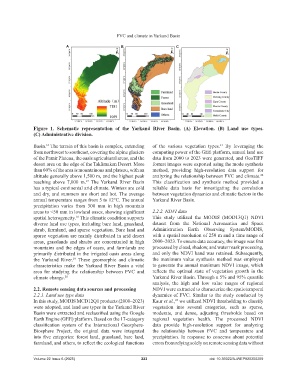
                Figure  1.  Schematic  representation of the  Yarkand River Basin. (A) Elevation.  (B) Land use types.
                (C) Administrative division.

                Basin.  The terrain of this basin is complex, extending   of  the  various  vegetation  types.   By  leveraging  the
                                                                                                  21
                     16
                from northwest to southeast, covering the alpine glaciers   computing power of the GEE platform, annual land use
                of the Pamir Plateau, the oasis agricultural areas, and the   data from 2000 to 2023 were generated, and GeoTIFF
                desert area on the edge of the Taklimakan Desert. More   format images were exported using the mode synthesis
                than 60% of the area is mountainous and plateau, with an   method, providing high-resolution  data support for
                altitude generally above 1,500 m, and the highest peak   analyzing the relationship between FVC and climate.
                                                                                                                    22
                reaching above 7,000  m.   The  Yarkand River Basin   This  classification  and  synthesis  method  provided  a
                                       17
                has a typical continental arid climate. Winters are cold   reliable  data  basis for investigating  the  correlation
                and dry, and summers are short and hot. The average   between vegetation dynamics and climatic factors in the
                annual temperature ranges from 5 to 12°C. The annual   Yarkand River Basin.
                precipitation  varies from 300  mm in high mountain
                areas to <50 mm in lowland oases, showing significant   2.2.2. NDVI data
                spatial heterogeneity.  This climatic condition supports   This study utilized  the MODIS  (MOD13Q1)  NDVI
                                  18
                diverse land use types, including bare land, grassland,   dataset from the National  Aeronautics and Space
                shrub, farmland, and sparse vegetation. Bare land and   Administration  Earth  Observing  System/MODIS,
                sparse vegetation are mainly distributed in arid desert   with a spatial resolution of 250 m and a time range of
                areas, grasslands and shrubs are concentrated in high   2000–2023. To ensure data accuracy, the image was first
                mountains and the edges of oases, and farmlands are   processed by cloud, shadow, and water mask processing,
                primarily distributed in the irrigated oasis areas along   and only the NDVI band was retained. Subsequently,
                the Yarkand  River.   These geomorphic and climatic   the maximum  value synthesis method was employed
                                 19
                characteristics  make the Yarkand River Basin a vital   to generate the annual maximum NDVI image, which
                area  for studying  the  relationship  between  FVC and   reflects  the  optimal  state  of  vegetation  growth  in  the
                climate change. 20                                  Yarkand River Basin. Through a 5% and 95% quantile
                                                                    analysis, the  high and low value  ranges of regional
                2.2. Remote sensing data sources and processing     NDVI were extracted to characterize the spatiotemporal
                2.2.1. Land use type data                           dynamics of FVC. Similar to the study conducted by
                In this study, MODIS MCD12Q1 products (2000–2023)   Kaur et al.,  we utilized NDVI thresholding to classify
                                                                              23
                were adopted, and land use types in the Yarkand River   vegetation  into several categories,  such as sparse,
                Basin were extracted and reclassified using the Google   moderate,  and dense, adjusting thresholds based on
                Earth Engine (GEE) platform. Based on the 17-category   regional vegetation health.  The processed NDVI
                classification  system  of  the  International  Geosphere-  data provide high-resolution support for analyzing
                Biosphere Project,  the original  data  were integrated   the relationship between FVC and temperature  and
                into  five  categories:  forest  land,  grassland,  bare  land,   precipitation.  In response to concerns about  potential
                farmland, and others, to reflect the ecological functions   errors from relying solely on remote sensing data without


                Volume 22 Issue 6 (2025)                       223                           doi: 10.36922/AJWEP025350269

