


Page 230 - AJWEP-22-6
P. 230
Qin, et al.

                ground  validation,  we  conducted  field  measurements   respectively.  Combined with the dynamic adjustment
                                                                               24
                at  selected  sites (e.g.,  Yecheng,  Shache,  and Zepu   thresholds for land use types (woodland, grassland,
                counties) using a handheld NDVI device (GreenSeeker   bare land, farmland,  etc.), the FVC was categorized
                RT200, Trimble Inc., United States of America), which   into  five  levels:  low  coverage  (0  ≤  FVC  <  0.2),
                showed good agreement between remote sensing data   medium-low  coverage  (0.2  ≤  FVC  <  0.4),  medium
                and ground-measured NDVI values, with a correlation   coverage  (0.4  ≤  FVC  <  0.6),  medium-high  coverage
                coefficient  (R )  exceeding  0.85.  This  validation   (0.6 ≤ FVC < 0.8), and high coverage (0.8 ≤ FVC ≤ 1). 25
                             2
                enhances the reliability of the MODIS NDVI dataset for
                ecological analysis in the study area.              2.3.2. CV
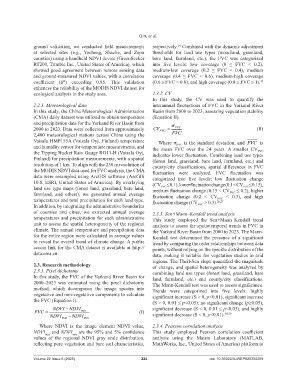
                                                                    In this study, the CV was used to quantify  the
                2.2.3. Meteorological data                          interannual fluctuations of FVC in the Yarkand River
                In this study, the China Meteorological Administration   Basin from 2000 to 2023, assessing vegetation stability
                (CMA) daily dataset was utilized to obtain temperature   (Equation II).
                and precipitation data for the Yarkand River Basin from
                2000 to 2023. Data were collected from approximately   CV FVC    FVC                             (II)
                2,400 meteorological  stations across China  using the       FVC
                Vaisala HMP155A (Vaisala Oyj, Finland) temperature     Where σ    is the standard deviation, and  FVC  is
                                                                               FVC
                and humidity sensor for temperature measurements, and   the mean FVC over the 24  years.  A  smaller  CV
                                                                                                                  FVC
                the Tipping Bucket Rain Gauge RG13-H (Vaisala Oyj,   indicates lower fluctuation. Combining land use types
                Finland) for precipitation measurements, with a spatial   (forest  land,  grassland,  bare  land,  farmland,  etc.)  and
                resolution of 1 km. To align with the 250 m resolution of   county/city  classifications,  spatial  differences  in  FVC
                the MODIS NDVI data used for FVC analysis, the CMA   fluctuation  were  analyzed.  FVC  fluctuation  was
                data were resampled using ArcGIS software (ArcGIS   categorized  into  five  levels:  low  fluctuation  change
                10.8, ESRI, United States of America). By overlaying   (CV   ≤ 0.1), lower fluctuation change (0.1 < CV   ≤ 0.15),
                                                                                                            FVC
                land use type maps (forest land, grassland, bare land,   medium fluctuation change (0.15 < CV   ≤ 0.2), higher
                                                                        FVC
                farmland, and others), we generated annual average   fluctuation  change  (0.2  <  CV    ≤  0.3),  and  high
                                                                                                      FVC
                temperatures and total precipitation for each land type.   fluctuation change (CV   > 0.3). 26,27
                                                                                                 FVC
                In addition, by integrating the administrative boundaries               FVC
                of counties and cities,  we extracted  annual  average   2.3.3. Sen+Mann–Kendall trend analysis
                temperatures and precipitation for each administrative   This study employed  the  Sen+Mann–Kendall  trend
                unit to assess the spatial heterogeneity of the regional   analysis to assess the spatiotemporal trends in FVC in
                climate. The annual temperature and precipitation data   the Yarkand River Basin from 2000 to 2023. The Mann-
                for the entire region were calculated as average values   Kendall  test  determined  the  presence  of  a  significant
                to reveal the overall trend of climate change. A public   trend by comparing the order relationships between data
                access link for the CMA dataset is available at http://  points, without relying on the specific distribution of the
                data.cma.cn.                                        data, making it suitable for vegetation studies in arid

                                                                    regions. The Theil-Sen slope quantified the magnitude
                2.3. Research methodology                           of change, and spatial heterogeneity was analyzed by
                2.3.1. Pixel dichotomy                              combining land use types (forest land, grassland, bare
                In this study, the FVC of the Yarkand River Basin for   land,  farmland,  etc.)  and  county/city  classifications.
                2000–2023 was estimated  using the pixel dichotomy   The Mann-Kendall test was used to assess significance.
                method,  which decomposes the  image  spectra  into   Trends  were  categorized  into  five  levels:  highly
                vegetative and non-vegetative components to calculate   significant increase (S > 0, p<0.01), significant increase
                the FVC (Equation I).                               (S > 0, 0.01 ≤ p<0.05), no significant change (p≥0.05),

                        NDVI NDVI��                                significant decrease (S < 0, 0.01 ≤ p<0.05), and highly
                FVC                 min                      (I)                                   28,29
                       NDVI max   ��  NDVI min                     significant decrease (S < 0, p<0.01).
                  Where  NDVI is  the  image  element  NDVI value,   2.3.4. Pearson correlation analysis
                NDVI  and NDVI  are the 95% and 5% confidence       This  study  employed  Pearson  correlation  coefficient
                                 min
                     max
                values  of the  regional  NDVI gray scale  distribution,   analysis using the Matrix Laboratory (MATLAB,
                reflecting pure vegetation and bare soil characteristics,   MathWorks, Inc., United States of America) platform to


                Volume 22 Issue 6 (2025)                       224                           doi: 10.36922/AJWEP025350269

