


Page 233 - AJWEP-22-6
P. 233
FVC and climate in Yarkand Basin

                 Table 4. Share percentage and acreage of fractional vegetation cover coefficient of fluctuation in different
                 land use types

                 Degree of fluctuation               Administrative units in the Yarkand River Basin (%; km )
                                                                                                     2
                                        Farmland      Forests    Grassland      Bare land     Others      Entire area
                 Low fluctuation          23.02;      22.18;        2.71;         0.73;        7.49;         3.90;
                 change                  1,741.53     11.82        423.27        312.08       243.17        2,719.20
                 Lower fluctuation        33.55;      46.16;       13.70;         4.50;        39.25;        11.46;
                 change                  2,538.08     24.60       2,138.89      1,919.62      1,274.88      7,994.74
                 Medium fluctuation       16.81;      21.24;       19.57;         6.90;        39.03;        12.36;
                 change                  1,271.58     11.32       3,055.42      2,945.40      1,267.78      8,624.87
                 Higher fluctuation       13.10;       7.98;       29.12;        13.36;        0.63;         16.33;
                 change                  991.01        4.25       4,547.28      5,704.27       20.63       11,394.23
                 High fluctuation         13.52;       2.44;       34.90;        74.51;        13.60;        55.95;
                 change                  1,022.82      1.30       5,449.99      31,799.37     441.65       39,038.96


                              A                                   B


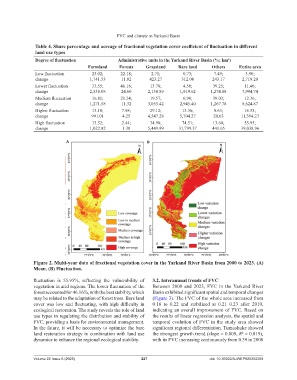
                Figure 2. Multi-year data of fractional vegetation cover in the Yarkand River Basin from 2000 to 2023. (A)
                Mean. (B) Fluctuation.

                fluctuation  is  55.95%,  reflecting  the  vulnerability  of   3.2. Interannual trends of FVC
                vegetation in arid regions. The lower fluctuation of the   Between 2000 and 2023, FVC in the  Yarkand River
                forest accounted for 46.16%, with the best stability, which   Basin exhibited significant spatial and temporal changes
                may be related to the adaptation of forest trees. Bare land   (Figure 3). The FVC of the whole area increased from
                cover was low and fluctuating, with high difficulty in   0.16 to 0.22 and  stabilized  at  0.21–0.23 after  2010,
                ecological restoration. The study reveals the role of land   indicating an overall improvement of FVC. Based on
                use types in regulating the distribution and stability of   the results of linear regression analysis, the spatial and
                FVC, providing a basis for environmental management.   temporal evolution of FVC in the study area showed
                In the future, it will be necessary to optimize the bare   significant regional differentiation. Tumushuke showed
                land restoration strategy in combination with land use   the strongest growth trend (slope = 0.009, R  = 0.819),
                                                                                                            2
                dynamics to enhance the regional ecological stability.  with its FVC increasing continuously from 0.39 in 2000


                Volume 22 Issue 6 (2025)                       227                           doi: 10.36922/AJWEP025350269

