


Page 238 - AJWEP-22-6
P. 238
Qin, et al.

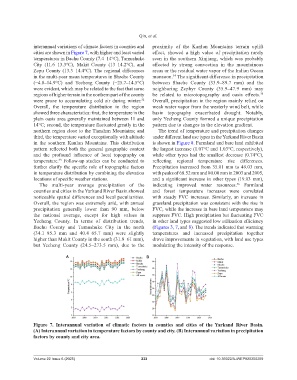
                interannual variations of climate factors in counties and   proximity of the Kunlun Mountains terrain uplift
                cities are shown in Figure 7, with higher and least varied   effect,  showed  a  high  value  of  precipitation  rarely
                temperatures in Bachu County (7.4–14°C), Tumushuke   seen in the southern Xinjiang, which was probably
                City (11.6–13.3°C), Makit County (13–14.2°C), and   affected  by  strong  convection  in  the  mountainous
                Zepu County (13.3–14.4°C). The regional differences   areas or the residual water vapor of the Indian Ocean
                in the multi-year mean temperatures in Shache County   monsoon.  The significant difference in precipitation
                                                                             34
                (−4.8–14.9°C)  and  Yecheng  County  (−25.7–14.5°C)   between Shache County (33.9–89.7  mm) and the
                were evident, which may be related to the fact that some   neighboring  Zephyr  County  (35.9–47.9  mm)  may
                regions of higher terrain in the northern part of the county   be related to microtopography  and  oasis  effects.
                                                                                                                    35
                were prone to accumulating cold air during winter.    Overall, precipitation in the region mainly relied on
                                                               32
                Overall,  the  temperature  distribution  in  the  region   weak water vapor from the westerly wind belt, while
                showed three characteristics: first, the temperature in the   basin topography exacerbated drought. Notably,
                plain oasis area generally maintained between 11 and   only Yecheng County formed a unique precipitation
                14°C; second, the temperature fluctuated greatly in the   pattern due to changes in the elevation gradient.
                northern region close to the Tianshan Mountains; and   The trend of temperature and precipitation changes
                third, the temperature varied exceptionally with altitude   under different land use types in the Yarkand River Basin
                in the southern Kunlun Mountains.  This distribution   is shown in Figure 8. Farmland and bare land exhibited
                pattern  reflected  both  the  general  geographic context   the largest increase (1.07°C and 1.03°C, respectively),
                and  the  profound  influence  of  local  topography on   while other types had the smallest decrease (0.74°C),
                temperature.  Follow-up studies can be conducted to   reflecting  regional  temperature  rise  differences.
                           33
                further clarify the specific role of topographic factors   Precipitation increased from 35.01 mm to 49.03 mm,
                in temperature distribution by combining the elevation   with peaks of 68.52 mm and 80.00 mm in 2003 and 2005,
                locations of specific weather stations.             and a significant increase in other types (19.03 mm),
                  The  multi-year  average  precipitation  of  the   indicating  improved water resources.  Farmland
                                                                                                         36
                counties and cities in the Yarkand River Basin showed   and forest temperature  increases were correlated
                noticeable spatial differences and local peculiarities.   with steady FVC increases. Similarly, an increase in
                Overall, the region was extremely arid, with annual   grassland precipitation was consistent with the rise in
                precipitation generally lower than 90  mm, below    FVC, while the increase in bare land temperature may
                the national average, except for high values in     suppress FVC. High precipitation but fluctuating FVC
                Yecheng County. In terms of distribution trends,    in other land types suggested low utilization efficiency
                Bachu County and  Tumushuke City in the north       (Figures 3, 7, and 8). The trends indicated that warming
                (34.1–85.3  mm and 40.4–65.7  mm) were slightly     temperatures  and increased precipitation  together
                higher than Makit County in the south (31.8–61 mm),   drove improvements in vegetation, with land use types
                but  Yecheng  County (24.5–273.5  mm),  due  to the   modulating the intensity of the response.


                              A                                   B


                Figure  7. Interannual variation of climatic  factors  in counties and cities  of the  Yarkand River Basin.
                (A) Interannual variation in temperature factors by county and city. (B) Interannual variation in precipitation
                factors by county and city area.


                Volume 22 Issue 6 (2025)                       232                           doi: 10.36922/AJWEP025350269

