


Page 242 - AJWEP-22-6
P. 242
Qin, et al.


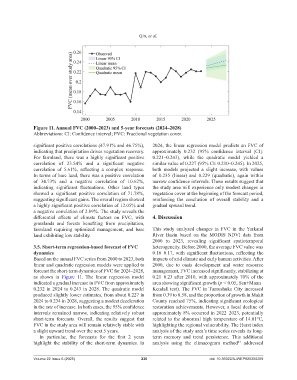
                Figure 11. Annual FVC (2000–2023) and 5-year forecasts (2024–2028)
                Abbreviations: CI: Confidence interval; FVC: Fractional vegetation cover.

                significant positive correlations (47.91% and 46.75%),   2024, the linear regression model predicts an FVC of
                indicating that precipitation drives vegetation recovery.   approximately  0.232  (95%  confidence  interval  [CI]:
                For  farmland,  there  was  a  highly  significant  positive   0.221–0.243), while  the  quadratic  model  yielded  a
                correlation  of  23.54%  and  a  significant  negative   similar value of 0.227 (95% CI: 0.210–0.245). In 2025,
                correlation  of  5.61%,  reflecting  a  complex  response.   both  models  projected  a  slight  increase,  with  values
                In terms of bare land, there was a positive correlation   of 0.235 (linear) and 0.229 (quadratic),  again  within
                of 34.73% and a negative correlation  of 10.62%,    narrow confidence intervals. These results suggest that
                indicating  significant  fluctuations.  Other  land  types   the study area will experience only modest changes in
                showed  a  significant  positive  correlation  of  71.78%,   vegetation cover at the beginning of the forecast period,
                suggesting significant gains. The overall region showed   reinforcing  the conclusion  of overall  stability  and  a
                a highly significant positive correlation of 12.05% and   gradual upward trend.
                a negative correlation of 2.89%. The study reveals the
                differential  effects  of  climate  factors  on  FVC,  with   4. Discussion
                grasslands  and  forests  benefiting  from  precipitation,
                farmland  requiring  optimized  management,  and bare   This study analyzed  changes in FVC in the Yarkand
                land exhibiting low stability.                      River Basin based on the MODIS  NDVI  data from
                                                                    2000  to  2023,  revealing  significant  spatiotemporal
                3.5. Short-term regression-based forecast of FVC    heterogeneity. Before 2000, the average FVC value was
                dynamics                                            0.16–0.17,  with  significant  fluctuations,  reflecting  the
                Based on the annual FVC series from 2000 to 2023, both   impacts of arid climate and early human activities. After
                linear and quadratic regression models were applied to   2000, due  to  oasis  development  and  water  resource
                forecast the short-term dynamics of FVC for 2024–2028,   management, FVC increased significantly, stabilizing at
                as  shown  in  Figure  11.  The  linear  regression  model   0.21–0.23 after 2010, with approximately 70% of the
                indicated a gradual increase in FVC from approximately   area showing significant growth (p < 0.05, Sen+Mann–
                0.232 in 2024 to 0.243 in 2028. The quadratic model   Kendall test). The FVC in Tumushuke City increased
                produced slightly lower estimates, from about 0.227 in   from 0.39 to 0.58, and the proportion of growth in Makit
                2024 to 0.234 in 2028, suggesting a modest deceleration   County reached 75%, indicating significant ecological
                in the rate of increase. In both cases, the 95% confidence   restoration achievements. However, a local decline of
                intervals remained narrow, indicating relatively robust   approximately 8% occurred in 2022–2023, potentially
                short-term forecasts. Overall, the results suggest that   related to the abnormal high temperature of 14.01°C,
                FVC in the study area will remain relatively stable with   highlighting the regional vulnerability. The Hurst index
                a slight upward trend over the next 5 years.        analysis of the study area’s time series reveals its long-
                  In  particular,  the  forecasts  for  the  first  2  years   term memory and trend persistence.  This additional
                highlight  the  stability  of the  short-term  dynamics.  In   analysis using the climacogram method  addressed
                                                                                                          41


                Volume 22 Issue 6 (2025)                       236                           doi: 10.36922/AJWEP025350269

