


Page 241 - AJWEP-22-6
P. 241
FVC and climate in Yarkand Basin

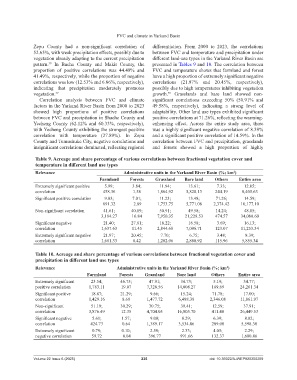
                Zepu  County  had  a  non-significant  correlation  of   differentiation.  From  2000  to  2023,  the  correlations
                52.65%, with weak precipitation effects, possibly due to   between FVC and temperature and precipitation under
                vegetation already adapting to the current precipitation   different land-use types in the Yarkand River Basin are
                pattern.  In Bachu  County and Makit  County, the   presented in Tables 9 and 10. The correlation between
                      39
                proportion  of positive  correlations  was 44.48% and   FVC and temperature shows that farmland and forest
                41.49%, respectively, while the proportion of negative   have a high proportion of extremely significant negative
                correlations was low (12.53% and 6.86%, respectively),   correlations  (21.97% and 20.45%, respectively),
                indicating  that  precipitation  moderately  promotes   possibly due to high temperatures inhibiting vegetation
                vegetation. 37                                      growth.  Grasslands and bare  land  showed non-
                                                                           39
                  Correlation  analysis between  FVC and climate    significant  correlations  exceeding  50%  (50.91%  and
                factors in the Yarkand River Basin from 2000 to 2023   49.58%, respectively), indicating a strong level of
                showed high  proportions  of  positive  correlations   adaptability. Other land use types exhibited significant
                between FVC and precipitation in Shache County and   positive correlations at 71.26%, reflecting the warming-
                Yecheng County (62.12% and 60.33%, respectively),   enhancing  effect.  Across  the  entire  study  area,  there
                with Yecheng County exhibiting the strongest positive   was a highly significant negative correlation of 8.39%
                correlation  with temperature (27.89%). In Zepu     and a significant positive correlation of 14.59%. In the
                County and Tumushuke City, negative correlations and   correlation between FVC and precipitation, grasslands
                insignificant correlations dominated, reflecting regional   and forests showed a high proportion of highly

                 Table 9. Acreage and share percentage of various correlations between fractional vegetation cover and
                 temperature in different land use types
                 Relevance                             Administrative units in the Yarkand River Basin (%; km )
                                                                                                        2
                                             Farmland     Forests    Grassland    Bare land     Others    Entire area
                 Extremely significant positive   5.99;    3.84;       11.94;       13.61;      7.33;       12.05;
                 correlation                  458.36        1.58      1,864.92     5,828.13     244.19      8,405.63
                 Significant positive correlation  9.03;   7.01;       11.23;       13.48;      71.26;      14.59;
                                              691.32        2.89      1,753.75     5,771.08    2,374.42    10,177.10
                 Non-significant correlation   41.61;      40.89;      50.91;       49.58;      14.24;      48.85;
                                              3,184.27     16.84      7,950.35    21,228.53     474.57     34,080.60
                 Significant negative          21.40;      27.81;      18.22;       16.58;      3.69;       16.13;
                 correlation                  1,637.63     11.45      2,844.68     7,096.71     123.07     11,253.34
                 Extremely significant negative   21.97;   20.45;       7.70;       6.75;       3.48;        8.39;
                 correlation                  1,681.33      8.42      1,202.06     2,888.92     115.96      5,855.34


                 Table 10. Acreage and share percentage of various correlations between fractional vegetation cover and
                 precipitation in different land use types
                 Relevance                          Administrative units in the Yarkand River Basin (%; km )
                                                                                                     2
                                       Farmland      Forests     Grassland     Bare land      Others      Entire area
                 Extremely significant   23.54;       46.75;       47.91;        34.73;        5.19;        34.77;
                 positive correlation   1,783.11      19.07       7,328.56     14,808.27      169.69       24,261.34
                 Significant positive    18.87;       21.29;       9.66;         15.24;       71.78;        17.00;
                 correlation            1,429.16       8.68       1,477.72      6,498.38     2,346.08      11,861.97
                 Non-significant         51.19;       30.29;       30.75;        39.41;       12.59;        37.91;
                 correlation            3,876.49      12.35       4,704.05     16,805.70      411.48       26,449.53
                 Significant negative     5.61;        1.57;       9.08;         8.29;         6.39;         8.02;
                 correlation             424.73        0.64       1,389.17      3,534.86      209.00       5,598.30
                 Extremely significant    0.79;        0.10;       2.59;         2.33;         4.05;         2.29;
                 negative correlation    59.72          0.04      396.77        991.66        132.37       1,600.86


                Volume 22 Issue 6 (2025)                       235                           doi: 10.36922/AJWEP025350269

