


Page 237 - AJWEP-22-6
P. 237
FVC and climate in Yarkand Basin

                techniques,  providing favorable  conditions  for   ecological vulnerability of FVC at the local scale in the
                vegetation  growth. In addition,  farmland  protection   Yarkand River Basin. The positive persistence in oasis
                policies  and land  reclamation  measures  create  a   areas indicated that irrigated agriculture and ecological
                conducive environment  for the development  of      restoration  measures  (e.g.,  afforestation)  support
                vegetation.  However, in mountainous  areas, complex   long-term FVC stability, while the anti-persistence in
                terrain  combined with harsh climatic  conditions  and   desert areas reflected constraints from aridity and wind
                surface exposure due to snowmelt restricts vegetation   erosion, and mountainous areas were limited by terrain
                growth potential.                                   and precipitation, making FVC susceptible to short-term
                  The  Hurst  coefficients  in  the Yarkand  River  Basin   disturbances (e.g., drought, floods). The Hurst coefficient
                reflect the impact of spatial heterogeneity on vegetation   of 0.81 for the annual mean FVC suggested long-term
                dynamics. The positive persistence in oasis areas was   stability of FVC at the regional scale, likely driven by
                offset by the anti-persistence in desert and mountainous   the dominant role of oasis areas and regional ecological
                areas,  resulting  in  a  lower  mean  Hurst  coefficient   policies,  such  as  afforestation,  oasis  expansion,  and
                across the entire grid. Desert areas, affected by extreme   optimized  water resource management.  Climatic
                aridity  and  wind  erosion,  experienced  significant   factors (e.g., precipitation fluctuation, temperature rise)
                fluctuations in FVC with easily reversible trends, while   and human activities  (e.g., agricultural  reclamation,
                mountainous areas, constrained by terrain and climate,   overgrazing) further exacerbate  spatial  heterogeneity,
                exhibited unstable changes in FVC. These local-scale   shaping  the  distinct  FVC  dynamics  across  different
                anti-persistent  trends,  combined  with  the  positive   geomorphic units.
                persistence in oasis areas, shaped the spatial distribution
                of the Hurst coefficient across the region. The regional-  3.4. Analysis of drivers of FVC
                scale  positive  persistence  (H = 0.81) highlighted   3.4.1. Spatial distribution and interannual fluctuation
                the  stabilizing contribution  of oasis agriculture  and   of climate factors
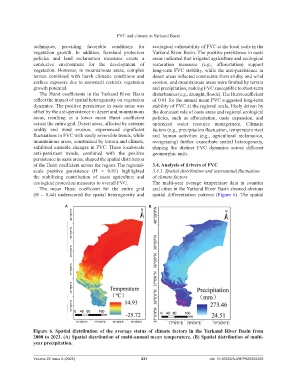
                ecological protection measures to overall FVC.      The multi-year average temperature  data in counties
                  The  mean  Hurst  coefficient  for  the  entire  grid   and cities in the Yarkand River Basin showed obvious
                (H = 0.44) underscored the spatial  heterogeneity  and   spatial  differentiation  patterns  (Figure  6). The  spatial


                              A                                    B


                Figure  6. Spatial distribution  of the average status  of climate factors in the Yarkand  River Basin  from
                2000 to 2023. (A) Spatial distribution of multi-annual mean temperature. (B) Spatial distribution of multi-
                year precipitation.


                Volume 22 Issue 6 (2025)                       231                           doi: 10.36922/AJWEP025350269

