


Page 239 - AJWEP-22-6
P. 239
FVC and climate in Yarkand Basin

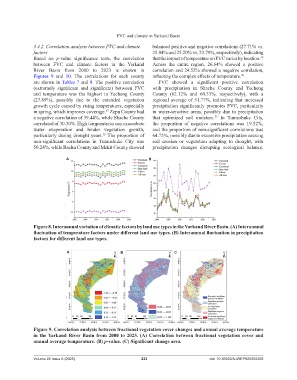
                3.4.2. Correlation analysis between FVC and climate   balanced positive and negative correlations (27.71% vs.
                factors                                             25.84% and 25.20% vs. 23.79%, respectively), indicating
                Based on  p-value  significance  tests,  the  correlation   that the impact of temperature on FVC varies by location.
                                                                                                                    39
                between FVC and climate  factors in the  Yarkand    Across  the  entire  region,  26.64%  showed  a  positive
                River  Basin  from  2000 to 2023 is shown in        correlation and 24.52% showed a negative correlation,
                Figures  9 and  10.  The correlations  for each county   reflecting the complex effects of temperature. 40
                are shown in Tables 7 and 8. The positive correlation   FVC  showed  a  significant  positive  correlation
                (extremely  significant  and  significant)  between  FVC   with precipitation  in Shache  County and  Yecheng
                and  temperature  was the  highest  in  Yecheng  County   County (62.12% and 60.33%, respectively),  with a
                (27.89%), possibly due to the extended vegetation   regional average of 51.77%, indicating that increased
                growth cycle caused by rising temperatures, especially   precipitation  significantly  promotes  FVC,  particularly
                in spring, which improves coverage.  Zepu County had   in water-sensitive  areas,  possibly due to precipitation
                                                37
                a negative correlation of 39.44%, while Shache County   that  optimized  soil moisture.  In  Tumushuke City,
                                                                                                37
                correlated of 30.30%. High temperatures can exacerbate   the proportion of negative  correlations  was 19.52%,
                water  evaporation  and  hinder  vegetation  growth,   and the proportion of non-significant correlations was
                particularly during drought years.  The proportion of   64.75%, possibly due to excessive precipitation causing
                                              38
                non-significant  correlations  in  Tumushuke  City  was   soil erosion or vegetation  adapting  to drought, with
                50.24%, while Bachu County and Makit County showed   precipitation  changes disrupting ecological  balance.


                              A                                   B


                Figure 8. Interannual variation of climatic factors by land use types in the Yarkand River Basin. (A) Interannual
                fluctuation of temperature factors under different land use types. (B) Interannual fluctuation in precipitation
                factors for different land use types.


                              A                       B                       C


                Figure 9. Correlation analysis between fractional vegetation cover changes and annual average temperature
                in the Yarkand River Basin from 2000 to 2023. (A) Correlation between fractional vegetation cover and
                annual average temperature. (B) p‑value. (C) Significant change area.


                Volume 22 Issue 6 (2025)                       233                           doi: 10.36922/AJWEP025350269

