


Page 62 - AJWEP-22-6
P. 62
Bahar, et al.

                              A                                    B


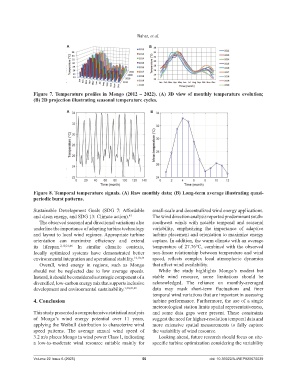
                Figure 7. Temperature profiles in Mongo (2012 – 2022). (A) 3D view of monthly temperature evolution;
                (B) 2D projection illustrating seasonal temperature cycles.


                              A                                    B


                Figure 8. Temporal temperature signals. (A) Raw monthly data; (B) Long-term average illustrating quasi-
                periodic burst patterns.

                Sustainable  Development  Goals  (SDG  7:  Affordable   small-scale and decentralized wind energy applications.
                and clean energy, and SDG 13: Climate action). 45   The wind direction analysis reported predominant south-
                  The observed seasonal and directional variations also   southwest winds with notable temporal  and seasonal
                underline the importance of adapting turbine technology   variability, emphasizing the importance  of adaptive
                and layout to local wind regimes. Appropriate turbine   turbine placement and orientation to maximize energy
                orientation  can  maximize  efficiency  and  extend   capture. In addition, the warm climate with an average
                its lifespan. 2,10,21,46  In similar  climatic  contexts,   temperature  of 27.76°C, combined with the observed
                locally  optimized  systems  have  demonstrated  better   non-linear relationship between temperature and wind
                environmental integration and operational stability. 12,18,35  speed,  reflects  complex  local  atmospheric  dynamics
                  Overall, wind energy in regions, such as Mongo    that affect wind availability.
                should not be neglected due to low average speeds.     While the study highlights Mongo’s modest but
                Instead, it should be considered a strategic component of a   stable wind resource, some limitations  should be
                diversified, low-carbon energy mix that supports inclusive   acknowledged.  The  reliance  on  monthly-averaged
                development and environmental sustainability. 7,30,47,48  data  may  mask  short-term  fluctuations  and  finer
                                                                    temporal wind variations that are important in assessing
                4. Conclusion                                       turbine performance. Furthermore, the use of a single
                                                                    meteorological station limits spatial representativeness,
                This study presented a comprehensive statistical analysis   and some data gaps were present.  These constraints
                of Mongo’s wind energy potential  over 11  years,   suggest the need for higher-resolution temporal data and
                applying the Weibull distribution to characterize wind   more extensive spatial measurements to fully capture
                speed patterns.  The  average  annual  wind speed of   the variability of wind resource.
                3.2 m/s places Mongo in wind power Class 1, indicating   Looking ahead, future research should focus on site-
                a low-to-moderate  wind resource suitable mainly  for   specific turbine optimization considering the variability


                Volume 22 Issue 6 (2025)                        56                           doi: 10.36922/AJWEP025070039

