


Page 102 - AN-3-3
P. 102
Advanced Neurology                                                 Proteomic analysis of microglia exosomes


            8  weeks old, were purchased from the Animal Model   and IL-4-treated microglia (M2-EXO) were subjected to
            Center of Nanjing University and housed under controlled   tandem mass tag (TMT)-based quantitative proteomics
            conditions with standard diets provided. The transient   at Jingjie PTM BioLab, China. The exosome samples in
            middle cerebral artery occlusion (tMCAO) model was   lysis buffer (8 M urea, 1% protease inhibitor cocktail)
            established as previously described.  After anesthetizing   were sonicated on ice 3  times and then centrifuged at
                                         14
            the mice, the middle cerebral artery was occluded using   12,000 × g for 10 min to collect the supernatant. Following
            a 6-0 surgical monofilament nylon suture (Doccol   the determination of concentration using a BCA kit, the
            Corporation, USA). Approximately 60 min later, the suture   protein samples were digested with trypsin and labeled
            was withdrawn to allow reperfusion. Following suture   with TMT. High pH reverse-phase HPLC was used to
            removal, exosomes from different phenotypes of microglia   fractionate  the  tryptic  peptides  using  an  Agilent  300
            were promptly administered through the tail vein with a   Extend-C18 column (5 μm particles, 4.6 mm ID, 250 mm
            daily dosage of 100 μg for 3 consecutive days.     length). The peptides were then analyzed using the EASY-
              The post-tMCAO brain tissue infarct volume was   nLC 1000 UPLC system (Thermo Fisher Scientific, Inc.,
            evaluated using 2% TTC (2,3,5 triphenyltetrazolium   USA) for  liquid chromatography-mass  spectrometry
            chloride; Sigma-Aldrich, USA). Briefly, following   (LC-MS)/MS  analysis.  The  acquired  MS/MS  data  were
            euthanasia, the brains were rapidly removed and sliced   processed with the Maxquant search engine (v.1.5.2.8,
            coronally into consecutive 1 mm sections. These slices were   Max Planck Institute of Biochemistry, Germany). Proteins
            then immersed in 2% TTC at 37°C for 20 min. Images of   were deemed significantly differentially expressed if
            the stained slices were captured and analyzed using ImageJ   the fold change in expression was >1.3 and the P < 0.05.
            software. To avoid data errors induced by cerebral edema,   Gene ontology (GO) and Kyoto Encyclopedia of Genes
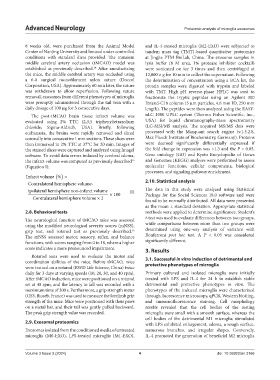
            the infarct volume was computed as previously described 15   and Genomes (KEGG) analyses were performed to assess
            (Equation I):                                      molecular functions, cellular components, biological
                                                               processes, and signaling pathway enrichment.
                         ( )
            Infarct volume  % =
             Contralateral hemisphere volume-                  2.10. Statistical analysis
             ipsilateral hemisphere non-infarct volume  (I)    The data in this study were analyzed using Statistical
                                                × 100          Package for the Social Sciences 18.0 software and were
               Contralateral hemisphere volume × 2
                                                               found to be normally distributed. All data were presented
                                                               as the mean ± standard deviation. Appropriate statistical
            2.8. Behavioral tests                              methods were applied to determine significance. Student’s
            The neurological function of tMCAO mice was assessed   t-test was used to evaluate differences between two groups,
            using the modified neurological severity scores (mNSS),   while comparisons between more than two groups were
            grip test, and rotarod test as previously described.    determined using one-way analysis of variance with
                                                         16
            The  mNSS  assessed  motor,  sensory,  reflex,  and  balance   Bonferroni  post  hoc test. A  P  < 0.05 was considered
            functions, with scores ranging from 0 to 18, where a higher   significantly different.
            score indicates a more pronounced impairment.      3. Results
              Rotarod tests were used to evaluate the motor and
            coordination abilities of the mice. Before tMCAO, mice   3.1. Successful in vitro induction of detrimental and
                                                               protective phenotypes of microglia
            were trained on a rotarod (RWD Life Science, China) twice
            daily for 3 days at varying speeds (10, 20, 30, and 40 rpm).   Primary cultured and isolated microglia were initially
            After tMCAO induction, mice were positioned on a rotarod   treated with LPS and IL-4 for 24  h to establish stable
            set at 40 rpm, and the latency to fall was recorded with a   detrimental and protective phenotypes  in vitro. The
            maximum time of 300 s. Furthermore, a grip strength meter   phenotypes of the induced microglia were characterized
            (GS3, Bioseb, France) was used to measure the forelimb grip   through fluorescence microscopy, qPCR, Western blotting,
            strength of the mice. Mice were positioned with their paws   and immunofluorescence staining. Cell morphology
            on a metal bar, and their tail was gently pulled backward.   results  revealed that  the  cell  bodies  of  the  resting
            The peak grip strength value was recorded.         microglia were small with a smooth surface, whereas the
                                                               cell bodies of the detrimental M1 microglia stimulated
            2.9. Exosomal proteomics                           with LPS exhibited enlargement, edema, a rough surface,
            Exosomes isolated from the conditioned media of untreated   numerous  branches,  and  irregular  shapes.  Conversely,
            microglia (M0-EXO), LPS-treated microglia (M1-EXO),   IL-4 promoted the generation of beneficial M2 microglia


            Volume 3 Issue 3 (2024)                         4                                doi: 10.36922/an.3166

