


Page 106 - AN-3-3
P. 106
Advanced Neurology                                                 Proteomic analysis of microglia exosomes


                         A                                     B


                         C                        D                     E


                         F                        G                     H


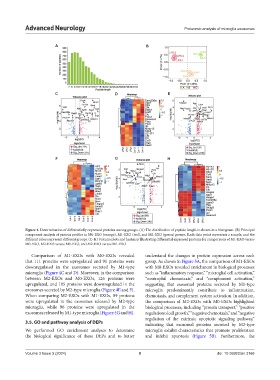
            Figure 4. Determination of differentially expressed proteins among groups. (A) The distribution of peptide length is shown in a histogram. (B) Principal
            component analysis of protein profiles in M0-EXO (orange), M1-EXO (red), and M2-EXO (green) groups. Each data point represents a sample, and the
            different colors represent different groups. (C-H) Volcano plots and heatmap illustrating differential expressed proteins for comparisons of M1-EXO versus
            M0-EXO, M2-EXO versus M0-EXO, and M2-EXO versus M1-EXO.

              Comparison of M1-EXOs with M0-EXOs revealed      understand the changes in protein expression across each
            that 111 proteins were upregulated and 91 proteins were   group. As shown in Figure 5A, the comparison of M1-EXOs
            downregulated in the exosomes secreted by M1-type   with M0-EXOs revealed enrichment in biological processes
            microglia (Figure 4C and D). Moreover, in the comparison   such as “inflammatory response,” “microglial cell activation,”
            between M2-EXOs and M0-EXOs, 126 proteins were     “neutrophil chemotaxis,” and “complement activation,”
            upregulated, and 105 proteins were downregulated in the   suggesting that exosomal proteins secreted by M1-type
            exosomes secreted by M2-type microglia (Figure 4E and F).   microglia predominantly contribute to inflammation,
            When comparing M2-EXOs with M1-EXOs, 89 proteins   chemotaxis, and complement system activation. In addition,
            were  upregulated  in  the  exosomes  released  by  M2-type   the comparison of M2-EXOs with M0-EXOs highlighted
            microglia, while 96 proteins were upregulated in the   biological processes, including “protein transport,” “positive
            exosomes released by M1-type microglia (Figure 4G and H).  regulation of cell growth,” “negative chemotaxis,” and “negative
                                                               regulation of the extrinsic apoptotic signaling pathway,”
            3.5. GO and pathway analysis of DEPs               indicating that exosomal proteins secreted by M2-type
            We performed GO enrichment analyses to determine   microglia exhibit characteristics that promote proliferation
            the  biological significance  of  these  DEPs  and to  better   and inhibit apoptosis (Figure  5B). Furthermore, the


            Volume 3 Issue 3 (2024)                         8                                doi: 10.36922/an.3166

