


Page 103 - AN-3-3
P. 103
Advanced Neurology                                                 Proteomic analysis of microglia exosomes


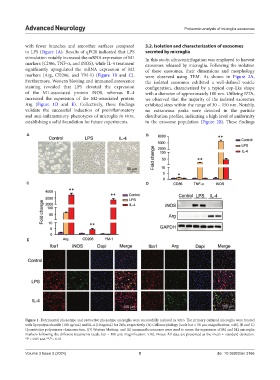
            with  fewer  branches  and  smoother  surfaces  compared   3.2. Isolation and characterization of exosomes
            to LPS (Figure 1A). Results of qPCR indicated that LPS   secreted by microglia
            stimulation notably increased the mRNA expression of M1   In this study, ultracentrifugation was employed to harvest
            markers (CD86, TNF-α, and iNOS), while IL-4 treatment   exosomes released by microglia. Following the isolation
            significantly upregulated the mRNA expression of M2   of these exosomes, their dimensions and morphology
            markers (Arg, CD206, and YM-1) (Figure  1B  and  C).   were observed using TEM. As shown in  Figure  2A,
            Furthermore, Western blotting and immunofluorescence   the isolated exosomes exhibited a well-defined vesicle
            staining revealed that LPS elevated the expression   configuration, characterized by a typical cup-like shape
            of the M1-associated protein iNOS, whereas IL-4    with a diameter of approximately 100 nm. Utilizing NTA,
            increased the expression of the M2-associated protein   we observed that the majority of the isolated exosomes
            Arg (Figure  1D  and  E). Collectively, these findings   exhibited sizes within the range of 30 – 150 nm. Notably,
            validate  the  successful  induction  of  proinflammatory   no extraneous peaks were detected in the particle
            and anti-inflammatory phenotypes of microglia in vitro,   distribution profiles, indicating a high level of uniformity
            establishing a solid foundation for future experiments.  in the exosome population (Figure  2B). These findings

            A                                                  B


            C                                                  D


            E


            Figure 1. Detrimental phenotype and protective phenotype microglia were successfully induced in vitro. The primary cultured microglia were treated
            with lipopolysaccharide (100 ng/mL) and IL-4 (10 ng/mL) for 24 h, respectively. (A) Cell morphology (scale bar = 50 μm; magnification: ×40), (B and C)
            Quantitative polymerase chain reaction, (D) Western blotting, and (E) immunofluorescence were used to assess the expression of M1 and M2 microglia
            markers following the different treatments (scale bar = 100 μm; magnification: ×10). Notes: All data are presented as the mean ± standard deviation.
            *P < 0.05 and **P < 0.01.


            Volume 3 Issue 3 (2024)                         5                                doi: 10.36922/an.3166

