


Page 54 - ARNM-1-1
P. 54
Advances in Radiotherapy
            & Nuclear Medicine                                                  Barcode system for immobilization device


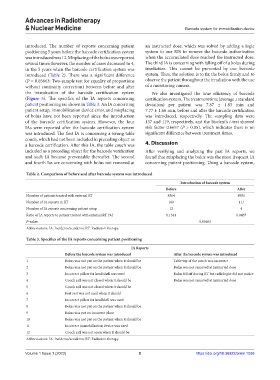
            introduced. The number of reports concerning patient   an instructed dose, which was solved by adding a logic
            positioning 5 years before the barcode certification system   system to our RIS to remove the barcode authorization
            was introduced was 12. Misplacing of the bolus was reported   when the accumulated dose reached the instructed dose.
            several times; however, the number of cases decreased to 4,   The third IA is concerning with falling off of a bolus during
            in the 5 years when the barcode certification system was   irradiation. This cannot be prevented by our barcode
            introduced  (Table  2).  There  was  a  significant  difference   system. Thus, the solution is to fix the bolus firmly and to
            (P = 0.03663: Two-sample test for equality of proportions   observe the patient throughout the irradiation with the use
            without continuity correction) between before and after   of a monitoring camera.
            the introduction of the barcode certification system   We also investigated the time efficiency of barcode
            (Figure  5). The specifics of the IA reports concerning   certification system. The treatment time (average ± standard
            patient positioning are shown in Table 3. An IA concerning   deviation) per patient was 7.87  ±  1.83  min and
            patient setup, immobilization device error, and misplacing   7.77 ± 1.66 min, before and after the barcode certification
            of bolus have not been reported since the introduction   was introduced, respectively. The sampling data were
            of the barcode certification system. However, the four   137 and 119, respectively, and the Student’s t-test showed
            IAs were reported after the barcode certification system   risk factor 0.6657 (P > 0.05), which indicates there is no
            was introduced. The first IA is concerning a wrong table   significant difference between treatment times.
            couch, which had not been included in preceding object as
            a barcode certification. After this IA, the table couch was   4. Discussion
            included as a preceding object for the barcode verification   After verifying and analyzing the past IA reports, we
            and  such  IA  became  preventable  thereafter.  The  second   found that misplacing the bolus was the most frequent IA
            and fourth Ias are concerning with bolus not removed at   concerning patient positioning. Using a barcode system,

            Table 2. Comparison of before and after barcode system was introduced

                                                                              Introduction of barcode system
                                                                        Before                        After
            Number of patients treated with external RT                 8564                          8951
            Number of IA reports in RT                                   160                           111
            Number of IA reports concerning patient setup                12                            4
            Ratio of IA reports to patient treated with external RT (%)  0.1341                       0.0467
            P-value                                                                   0.03663
            Abbreviations: IA: Incidents/accidents; RT: Radiation therapy.

            Table 3. Specifics of the IA reports concerning patient positioning
                                                         IA Reports
                             Before the barcode system was introduced      After the barcode system was introduced
            1                Bolus was not put on the patient when it should be  Table top of the couch was incorrect
            2                Bolus was not put on the patient when it should be  Bolus was not removed at instructed dose
            3                Incorrect pillow for head shell was used      Bolus fell off during RT but radiologist did not notice
            4                Couch rail was not closed when it should be   Bolus was not removed at instructed dose
            5                Couch rail was not closed when it should be
            6                Feet rest was not used when it should
            7                Incorrect pillow for headshell was used
            8                Bolus was not put on the patient when it should be
            9                Bolus was put on incorrect place
            10               Bolus was not put on the patient when it should be
            11               Incorrect immobilization device was used
            12               Couch rail was not open when it should be
            Abbreviations: IA: Incidents/accidents; RT: Radiation therapy.


            Volume 1 Issue 1 (2023)                         5                       https://doi.org/10.36922/arnm.1036

