


Page 59 - ARNM-1-1
P. 59
Advances in Radiotherapy
            & Nuclear Medicine                                                    Refractory pulmonary adenocarcinoma


                         A                            B             C             D


                                                       E                   F


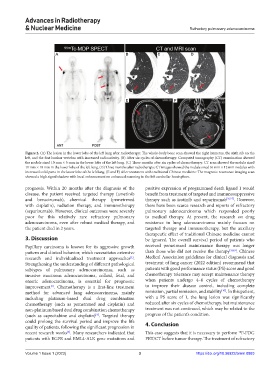
            Figure 2. (A) The lesion in the lower lobe of the left lung after radiotherapy: The whole-body bone scan showed the right humerus, the sixth rib on the
            left, and the first lumbar vertebra with increased radioactivity. (B) After six cycles of chemotherapy: Computed tomography (CT) examination showed
            the nodule sized 10 mm × 5 mm in the lower lobe of the left lung. (C) Three months after six cycles of chemotherapy: CT scan showed the nodule sized
            11 mm × 10 mm in the lower lobe of the left lung. (D) Three months after radiotherapy: CT images showed the nodule sized 16 mm × 12 mm nodules with
            increased solid parts in the lower lobe of the left lung. (E and F) After treatment with traditional Chinese medicine: The magnetic resonance imaging scan
            showed a high signal shadow with local enhancement on enhanced scanning in the left cerebellar hemisphere.

            prognosis. Within 20  months after the diagnosis of the   positive expression of programmed death ligand 1 would
            disease, the  patient  received  targeted  therapy  (ametinib   benefit from treatment of targeted and immunosuppressive
            and bevacizumab), chemical therapy (pemetrexed     therapy such as icotinib and separizumab [3,5-7] . However,
            with cisplatin), radiation therapy, and immunotherapy   there have been scarce research and reports of refractory
            (separizumab). However, clinical outcomes were severely   pulmonary adenocarcinoma which responded poorly
            poor for this relatively rare refractory pulmonary   to medical therapy. At present, the research on drug
            adenocarcinoma, even after robust medical therapy, and   resistance  in  lung  adenocarcinoma  mainly  focuses  on
            the patient died in 2 years.                       targeted therapy and immunotherapy, but the auxiliary
                                                               therapeutic effect of traditional Chinese medicine cannot
            3. Discussion                                      be ignored. The overall survival period of patients who

            Papillary carcinoma is known for its aggressive growth   received pemetrexed maintenance therapy was longer
            pattern and clinical behavior, which necessitates extensive   than those who did not receive the therapy [5,8,9] . Chinese
            research and individualized treatment approaches .   Medical Association guidelines for clinical diagnosis and
                                                        [1]
            Strengthening the understanding of different pathological   treatment of lung cancer (2022 edition) recommend that
            subtypes of pulmonary adenocarcinomas, such as     patients with good performance status (PS) score and good
            invasive mucinous adenocarcinoma, colloid, fetal, and   chemotherapy tolerance may accept maintenance therapy
            enteric  adenocarcinoma,  is  essential  for  prognostic   when patients undergo 4–6  cycles of chemotherapy
            improvement .  Chemotherapy  is  a  first-line  treatment   to improve their disease control, including complete
                       [2]
                                                                                               [10]
            method for advanced lung adenocarcinoma, mainly    remission, partial remission, and stability . In this patient,
            including  platinum-based dual drug combination    with  a  PS score of  1,  the  lung  lesion  was significantly
            chemotherapy (such as pemetrexed and cisplatin) and   reduced after six cycles of chemotherapy, but maintenance
            non-platinum based dual drug combination chemotherapy   treatment was not continued, which may be related to the
            (such as capecitabine and cisplatin) . Targeted therapy   progress of the patient’s condition.
                                          [3]
            could prolong the survival period and improve the life
            quality of patients, following the significant progression in   4. Conclusion
            recent research works . Many researchers indicated that   This case suggests that it is necessary to perform  F-FDG
                                                                                                      18
                              [4]
            patients with EGFR and EML4-ALK gene mutations and   PET/CT before tumor therapy. The treatment of refractory
            Volume 1 Issue 1 (2023)                         3                       https://doi.org/10.36922/arnm.0883

