


Page 58 - ARNM-1-1
P. 58
Advances in Radiotherapy
            & Nuclear Medicine                                                    Refractory pulmonary adenocarcinoma


            A
                                         B                     E                     H


                                         C                     F                     I


                                         D                     G                     J


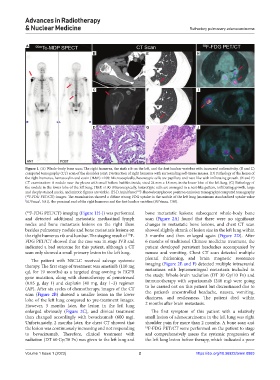
            Figure 1. (A) Whole-body bone scan: The right humerus, the sixth rib on the left, and the first lumbar vertebra with increased radioactivity. (B and C)
            computed tomography (CT) scan of the shoulder joint: Destruction of right humerus with surrounding soft-tissue masses. (D) Pathology of the lesion of
            the right humerus, hematoxylin and eosin (H&E) ×100: Microscopically, heterotypic cells are papillary and nest-like with infiltrating growth. (E and F)
            CT examination: A nodule near the pleura with small hollow bubbles inside, sized 24 mm × 18 mm, in the lower lobe of the left lung. (G) Pathology of
            the nodule in the lower lobe of the left lung, H&E ×100: Microscopically, heterotypic cells are arranged in a nest-like pattern, infiltrating growth, large
                                                           18
            and deeply stained nuclei, and mitotic figures are visible. (H-J) Axial fused  F-fluorodeoxyglucose positron emission tomography/computed tomography
            ( F-FDG PET/CT) images: The examination showed a diffuse strong FDG uptake in the nodule of the left lung (maximum standardized uptake value
            18
                  ]
            [ SUVmax , 5.81), the proximal end of the right humerus and the first lumbar vertebra (SUVmax, 7.98).
            ( F-FDG PET/CT) imaging (Figure 1H-J) was performed   bone metastatic lesions; subsequent whole-body bone
            18
            and detected additional metastatic mediastinal lymph   scan (Figure  2A) found that there were no significant
            nodes and bone metastasis lesions on the right illum   changes in metastatic bone lesions, and chest CT scan
            besides pulmonary nodule and bone metastasis lesions on   showed slightly shrank of lesion size in the left lung within
            the right humerus rib and lumbar. The staging result of  F-  3  months and then enlarged again (Figure  2D). After
                                                       18
            FDG PET/CT showed that the case was in stage IVB and   6 months of traditional Chinese medicine treatment, the
            indicated a bad outcome for this patient, although a CT   patient developed persistent headaches accompanied by
            scan only showed a small primary lesion in the left lung.  nausea and vomiting. Chest CT scan detected multiple
              The patient with NSCLC received salvage systemic   pleural thickening, and brain magnetic resonance
            therapy. The first stage of treatment was ametinib (110 mg   imaging (Figure 2E and F) detected multiple intracranial
            qd,  for  19  months)  as  a  targeted  drug  owning  to EGFR   metastases  with  leptomeningeal  metastasis  included  in
            gene mutation, along with chemotherapy of pemetrexed   the study. Whole-brain radiation (DT 30 Gy/10 Fx) and
            (0.85  g, day 1) and cisplatin (40  mg, day 1–3) regimen   immunotherapy with separizumab (240  mg) were going
            (AP). After six cycles of chemotherapy, images of the CT   to be carried out on this patient but discontinued due to
            scan (Figure  2B) showed a smaller lesion in the lower   the patient’s uncontrolled headache, nausea, vomiting,
            lobe of the left lung compared to pre-treatment images.   dizziness,  and  restlessness.  The  patient  died  within
            However, 3  months later, the lesion in the left lung   2 months after brain metastasis.
            enlarged obviously  (Figure  2C), and  clinical treatment   The  first  symptom  of  this  patient  with  a  relatively
            then  changed accordingly  with bevacizumab  (600  mg).   small lesion of adenocarcinoma in the left lung was right
            Unfortunately, 2 months later, the chest CT showed that   shoulder pain for more than 2 months. A bone scan and
            the lesion was continuously increasing and not responding   18 F-FDG PET/CT were performed on the patient to stage
            to bevacizumab. Therefore, clinical treatment with   and comprehensively  assess  the systemic  progression  of
            radiation (DT 60 Gy/30 Fx) was given to the left lung and   the left lung lesion before therapy, which indicated a poor


            Volume 1 Issue 1 (2023)                         2                       https://doi.org/10.36922/arnm.0883

