


Page 76 - ARNM-2-4
P. 76
Advances in Radiotherapy
            & Nuclear Medicine                                           Comparison of online ATP versus offline ATS plans


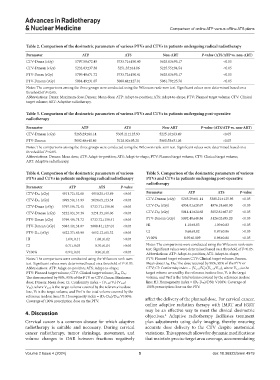
            Table 2. Comparison of the dosimetric parameters of various PTVs and CTVs in patients undergoing radical radiotherapy
            Parameter               ATP               ATS             Non‑ART          P‑value (ATS/ATP vs. non‑ART)
            CTV-Dmax (cGy)       5797.59±72.45     5733.71±150.40    5625.63±95.17              <0.05
            CTV-Dmean (cGy)      5232.03±37.38     5251.35±61.06     5225.55±94.54              <0.05
            PTV-Dmax (cGy)       5799.49±71.72     5733.72±150.41    5625.63±95.17              <0.05
            PTV-Dmean (cGy)      5084.49±31.07     5088.44±127.01    5061.79±25.76              <0.05
            Notes: The comparisons among the three groups were conducted using the Wilcoxon rank-sum test. Significant values were determined based on a
            threshold of P<0.05.
            Abbreviations: Dmax: Maximum dose; Dmean: Mean dose; ATP: Adapt-to-position; ATS: Adapt-to-shape; PTV: Planned target volume; CTV: Clinical
            target volume; ART: Adaptive radiotherapy.

            Table 3. Comparison of the dosimetric parameters of various PTVs and CTVs in patients undergoing post‑operative
            radiotherapy
            Parameter               ATP               ATS             Non‑ART         P‑value (ATS/ATP vs. non‑ART)
            CTV-Dmean (cGy)      5265.29±61.14    5305.21±125.93     5225.10±63.49              <0.05
            PTV-Dmean            5092.40±40.86     5126.02±95.20     5060.55±51.03              <0.05
            Notes: The comparisons among the three groups were conducted using the Wilcoxon rank-sum test. Significant values were determined based on a
            threshold of P<0.05.
            Abbreviations: Dmean: Mean dose; ATP: Adapt-to-position; ATS: Adapt-to-shape; PTV: Planned target volume; CTV: Clinical target volume;
            ART: Adaptive radiotherapy.

            Table 4. Comparison of the dosimetric parameters of various   Table 5. Comparison of the dosimetric parameters of various
            PTVs and CTVs in patients undergoing radical radiotherapy  PTVs and CTVs in patients undergoing post‑operative
                                                               radiotherapy
            Parameter         ATP          ATS      P‑value
            CTV-D98 (cGy)  4911.72±52.66  4950.25±43.89  <0.05  Parameter        ATP          ATS      P‑value
            CTV-D95 (cGy)  4995.50±14.99  5024.65±23.34  <0.05  CTV-Dmean (cGy)  5265.29±61.14  5305.21±125.93  <0.05
            CTV-Dmax (cGy)  5797.59±72.45  5733.71±150.40  <0.05  CTV-D98 (cGy)  4934.01±28.67  4976.18±60.90  <0.05
            CTV-Dmean (cGy)  5232.03±37.38  5251.35±61.06  <0.05  CTV-D95 (cGy)  5014.41±24.68  5052.61±67.87  <0.05
            PTV-Dmax (cGy)  5799.49±71.72  5733.72±150.41  <0.05  PTV-Dmean (cGy)  5092.40±40.86  5126.02±95.20  <0.05
            PTV-Dmean (cGy)  5084.49±31.07  5088.44±127.01  <0.05  HI           1.10±0.03   1.09±0.03   >0.05
            PTV-D95 (cGy)  4622.37±45.98  4652.12±65.32  <0.05  CI              0.68±0.02   0.67±0.06   >0.05
            HI               1.09±0.11   1.08±0.02   >0.05     V100%           0.95±0.009   0.96±0.01   <0.05
            CI               0.71±0.03   0.70±0.04   >0.05     Notes: The comparisons were conducted using the Wilcoxon rank-sum
                                                               test. Significant values were determined based on a threshold of P<0.05.
            V100%            0.94±0.01   0.96±0.01   <0.05     Abbreviations: ATP: Adapt-to-position; ATS: Adapt-to-shape;
            Notes: The comparisons were conducted using the Wilcoxon rank-sum   PTV: Planned target volume; CTV: Clinical target volume; Dmean,
            test. Significant values were determined based on a threshold of P<0.05.  Mean dose; D98, D95: The dose received by 98%, 95% of the PTV or
            Abbreviations: ATP: Adapt-to-position; ATS: Adapt-to-shape;    CTV; CI: Conformity index = (Vt, ref/Vt)·(Vt, ref/Vref), where Vt, ref is the
            PTV: Planned target volume; CTV: Clinical target volume; D98, D95:   target volume covered by the reference isodose line, Vt is the target
            The dose received by 98%, 95% of the PTV or CTV; Dmax: Maximum   volume, and Vref is the total volume covered by the reference isodose
            dose; Dmean: Mean dose; CI: Conformity index = (Vt, ref/Vt)·(Vt, ref/  line; HI: Homogeneity index = (D2-D98)/D50; V100%: Coverage of
            Vref), where Vt, ref is the target volume covered by the reference isodose   100% prescription dose on the PTV.
            line, Vt is the target volume, and Vref is the total volume covered by the
            reference isodose line; HI: Homogeneity index = (D2-D98)/D50; V100%:
            Coverage of 100% prescription dose on the PTV.     affect the delivery of the planned dose. For cervical cancer,
                                                               online adaptive radiation therapy with IMRT and IGRT
            4. Discussion                                      may be an effective way to meet the clinical dosimetric
                                                               objectives.  Adaptive radiotherapy facilitates treatment
                                                                       2
            Cervical cancer is a common disease for which adaptive   plan  adjustments  using  daily imaging, thereby ensuring
            radiotherapy is suitable and necessary. During cervical   accurate dose delivery to the CTV despite anatomical
            cancer radiotherapy, tumor shrinkage, movement, and   variations. This approach allows for dynamic modifications
            volume changes in OAR between fractions negatively   that maintain precise target area coverage, accommodating


            Volume 2 Issue 4 (2024)                         5                              doi: 10.36922/arnm.4919

