


Page 78 - ARNM-2-4
P. 78
Advances in Radiotherapy
            & Nuclear Medicine                                           Comparison of online ATP versus offline ATS plans


            the practicality of extensive ATS protocols because they   A             B
            considerably increase the treatment time per patient and
            disrupt the scheduling of subsequent treatments. Extended
            time on the treatment couch, without timely contour
            adjustments, can result in positional shifts of the target
            area and OAR, thereby necessitating recalculations of the
            dose distribution. Moreover, prolonged treatment sessions
            may negatively impact patient compliance. Furthermore,
            the substantial resource demands and specialized training
            required for ATS protocols pose significant barriers to
            their widespread adoption in clinical settings.
              In Peng  et  al.,  CBCT was used to design adaptive
                           2
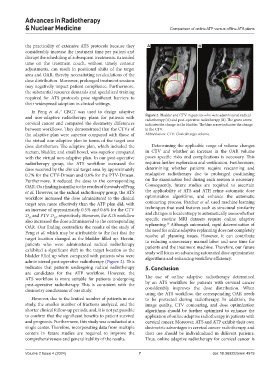
            and non-adaptive radiotherapy plans for patients with   Figure 2. Bladder and CTV in patients who were administered radical
                                                               radiotherapy (A) and post-operative radiotherapy (B). The green arrow
            cervical cancer and compared the dosimetry differences   indicates the change in the bladder. The blue arrow indicates the change
            between workflows. They demonstrated that the CTVs of   in the CTV.
            the adaptive plan were superior compared with those of   Abbreviation: CTV: Clinical target volume.
            the virtual non-adaptive plan in terms of the target area
            dose distribution. The adaptive plan, which included the   Determining the applicable range of volume changes
            rectum, bladder, and small bowel, was superior compared   in CTV and whether an increase in the OAR volume
            with the virtual non-adaptive plan. In our post-operative   poses specific risks and complications is necessary. This
            radiotherapy group, the ATS workflow increased the   requires further exploration and verification. Furthermore,
            dose received by the clinical target area by approximately   determining whether patients require rescanning and
            0.7% for the CTV-Dmean and 0.6% for the PTV-Dmean.   readaptive  radiotherapy  due  to  prolonged  positioning
            Furthermore,  it  reduced  the  dose  to  the  corresponding   on the examination bed during each session is necessary.
            OAR. Our finding is similar to the results of the study of Peng   Consequently,  future studies  are  required to  ascertain
            et al. However, in the radical radiotherapy group, the ATS   the applicability of ATS and ATP, refine automatic dose
            workflow increased the dose administered to the clinical   optimization  algorithms,  and  enhance  the  automatic
            target area more effectively than the ATP plan did, with   contouring process. Parchur et al. used machine learning
            an increase of approximately 0.5% and 0.6% for the CTV   techniques that used features such as structural similarity
            D  and PTV D , respectively. However, the ATS workflow   and changes in local entropy to automatically assess whether
                        95
             95
            also increased the dose administered to the corresponding   specific routine MRI datasets require online adaptive
                                                                        30
            OAR. Our finding contradicts the results of the study of   replanning.  Although automated, rapid determination of
                                                               the need for online adaptive replanning does not completely
            Peng et al. which may be attributable to the fact that the   resolve all planning issues. However, it can contribute
            target location changed as the bladder filled up. Herein,   to reducing unnecessary manual labor and save time for
            patients who were administered radical radiotherapy   patients and the treatment machine. Therefore, our future
            exhibited a significant shift in the target location as the   study will focus on advancing automated dose optimization
            bladder filled up when compared with patients who were   algorithms and enhancing workflow efficiency.
            administered post-operative radiotherapy (Figure 2). This
            indicates that patients undergoing radical radiotherapy   5. Conclusion
            are candidates for the ATP workflow. However, the
            ATS workflow is more suitable for patients undergoing   The use of online adaptive radiotherapy determined
            post-operative radiotherapy. This is consistent with the   by an ATS workflow for patients with cervical cancer
            dosimetry conclusions of our study.                considerably  improves  the  dose  distribution.  When
                                                               using the ATS workflow, the corresponding OAR needs
              However, due to the limited number of patients in our   to be protected during radiotherapy. In addition, the
            study, the smaller number of fractions analyzed, and the   image quality, CTV contouring, and dose optimization
            shorter clinical follow-up periods, and, it is not yet possible   algorithms should be further optimized to enhance the
            to confirm that the significant benefits to patient survival   application of online adaptive radiotherapy in patients with
            and prognosis. Furthermore, this study was conducted at a   cervical cancer. Moreover, ATS and ATP exhibit their own
            single center. Therefore, incorporating data from multiple   dosimetric advantages in cervical cancer radiotherapy, and
            centers in future studies are required to improve the   their use should be individualized in different patients.
            comprehensiveness and generalizability of the results.  Thus, online adaptive radiotherapy for cervical cancer is


            Volume 2 Issue 4 (2024)                         7                              doi: 10.36922/arnm.4919

