


Page 77 - ARNM-2-4
P. 77
Advances in Radiotherapy
            & Nuclear Medicine                                           Comparison of online ATP versus offline ATS plans


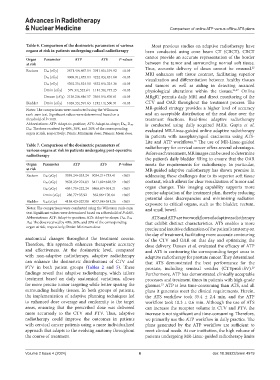
            Table 6. Comparison of the dosimetric parameters of various   Most previous studies on adaptive radiotherapy have
            organs at risk in patients undergoing radical radiotherapy  been conducted using cone beam CT (CBCT). CBCT
                                                               cannot provide an accurate representation of the border
            Organ   Parameter    ATP        ATS     P‑values
            at risk                                            between  the  tumor  and  surrounding  normal  soft  tissue.
                                                                                                            25
            Rectum  D40 (cGy)  3671.49±467.14 3911.85±519.92  <0.05  Thus, accurate delivery of doses cannot be ensured.
                    D30 (cGy)  4008.91±455.14 4222.03±431.68  <0.05  MRI enhances soft tissue contrast, facilitating superior
                                                               visualization and differentiation between healthy tissues
                    D20 (cGy)  4302.35±524.10 4532.84±324.36  <0.05  and  tumors  as well as  aiding  in  detecting  nuanced
                    Dmin (cGy)  579.34±523.64 1114.30±745.25  <0.05  physiological alterations within the tissues. 26,27  Online
                    Dmean (cGy) 3136.20±416.57 3564.54±476.61  <0.05  MRgRT permits daily MRI and direct monitoring of the
            Bladder  Dmin (cGy)  1028.33±391.63 1212.14±560.91  <0.05  CTV and OAR throughout the treatment process. The
            Notes: The comparisons were conducted using the Wilcoxon   MR-guided strategy provides a higher level of accuracy
            rank-sum test. Significant values were determined based on a   and an acceptable distribution of the real dose over the
            threshold of P<0.05.                               treatment fractions. Real-time adaptive radiotherapy
            Abbreviations: ATP: Adapt-to-position; ATS: Adapt-to-shape; D40, D30,   is  conducted  using  daily  acquired  MRIs.  Gupta  et al.
            D20: The dose received by 40%, 30%, and 20% of the corresponding   evaluated MR-Linac-guided online adaptive radiotherapy
            organ at risk, respectively; Dmin: Minimum dose; Dmean: Mean dose.
                                                               in  patients  with  nasopharyngeal  carcinoma  using  ATS-
                                                               Lite and ATP workflows.  The use of MR-Linac-guided
                                                                                    28
            Table 7. Comparison of the dosimetric parameters of
            various organs at risk in patients undergoing post‑operative   radiotherapy for cervical cancer offers several advantages.
            radiotherapy                                       Before each treatment, MR images can be used to determine
                                                               the patient’s daily bladder filling to ensure that the OAR
            Organ   Parameter   ATP         ATS     P‑values   meets  the  requirements  for radiotherapy. In  particular,
            at risk                                            MR-guided adaptive radiotherapy has shown promise in
            Rectum  D40 (cGy)  3339.24±333.24 3034.21±733.41  <0.05  addressing these challenges due to its superior soft tissue
                   D30 (cGy)  3678.23±274.83 3411.82±620.59  <0.05  contrast, which allows for clear visualization of tumor and
                   D20 (cGy)  4051.75±222.24 3866.87±501.21  <0.05  organ  changes. This imaging  capability  supports  more
                   Dmin (cGy)  250.77±35.92  362.86±170.64  <0.05  precise adaptation of the treatment plan, thereby reducing
            Bladder  V20 (cGy)  4158.42±327.08 4017.98±381.26  <0.05  potential dose discrepancies and minimizing radiation
                                                               exposure to critical organs, such as the bladder, rectum,
            Notes: The comparisons were conducted using the Wilcoxon rank-sum   and small bowel.
            test. Significant values were determined based on a threshold of P<0.05.
            Abbreviations: ATP: Adapt-to-position; ATS: Adapt-to-shape; D40, D30,   ATS and ATP are two workflows of adaptive radiotherapy
            D20: The dose received by 40%, 30%, and 20% of the corresponding   that exhibit distinct characteristics. ATS enables a more
            organ at risk, respectively; Dmin: Minimum dose.   precise and intuitive delineation of the patient’s anatomy on
                                                               the day of treatment, facilitating more accurate contouring
            anatomical changes throughout the treatment course.   of the CTV and OAR on that day and optimizing the
            Therefore, this approach enhances therapeutic accuracy   dose delivery. Dassen et al. evaluated the efficacy of ATP
            and effectiveness. At the dosimetric level, compared   and ATS in contouring the corresponding target areas in
            with  non-adaptive  radiotherapy,  adaptive  radiotherapy   adaptive radiotherapy for prostate cancer. They determined
            can enhance the dosimetric distributions of CTV and   that  ATS  demonstrated  the  best  performance  for  the
            PTV in both patient groups (Tables  2 and  5). These   prostate, including seminal vesicles (CTVproS+SV).
                                                                                                            29
            findings  reveal  that  adaptive  radiotherapy,  which  tailors   Furthermore, ATP has demonstrated clinically acceptable
            treatment based on  daily anatomical variations,  allows   processes and treatment times in patients with high-grade
            for more precise tumor targeting while better sparing the   gliomas.  ATP is less time-consuming than ATS, and all
                                                                      23
            surrounding healthy tissues. In both groups of patients,   plans it generates meet the clinical requirements. Herein,
            the  implementation of  adaptive  planning  techniques  led   the ATS workflow took 35.4 ± 2.4  min, and the ATP
            to enhanced dose coverage and conformity to the target   workflow took 10.3 ± 0.6 min. Although the use of ATS
            areas, ensuring  that the prescribed dose was delivered   can increase the receptor volume in CTV and PTV, the
            more accurately to the CTV and PTV. Thus, adaptive   increase is not significant and time-consuming. Therefore,
            radiotherapy could improve the outcomes in patients   we primarily use the ATP workflow in daily practice. The
            with cervical cancer patients using a more individualized   plans  generated by  the  ATP  workflow  are  sufficient  to
            approach that adapts to the evolving anatomy throughout   meet clinical needs. At our institution, the high volume of
            the course of treatment.                           patients undergoing MR-Linac-guided radiotherapy limits


            Volume 2 Issue 4 (2024)                         6                              doi: 10.36922/arnm.4919

