


Page 82 - ARNM-2-4
P. 82
Advances in Radiotherapy
            & Nuclear Medicine                                               Dose-volume histogram and gamma analysis


            of localized prostate cancer.  Today, it is known that   the percentage of approved points, the treatment plan is
                                    3
            enhancing  the  local  control  of  a  disease  requires  a  dose   approved  for use in  the  patient. The  acceptable  gamma
            increase for treatment planning target volume (PTV).   passing rates range from 90% to 95%.
            However, this often poses a challenge when considering the   Even so, not all the parameters for this assessment are
            dose tolerances of adjacent normal tissues. Separately, the   fully established. To overcome these challenges, guidelines
            European Guidelines recommended the use of intensity-  were developed to provide better guidance on the proper
            modulated radiation therapy (IMRT) as the standard   selection and use of the dosimetry tools available for IMRT
            treatment for prostate cancer. 4,5                 QA, including algorithms, software, and devices.  One of
                                                                                                      8
              Planning with the IMRT technique allows the delivery   the problems has been the effectiveness of using the gamma
            of the dose to the PTV with a high degree of conformation   index to evaluate the clinical relevance of delivering a dose
            while satisfactorily restricting the dose limit in the organs   to the patient, 9-11  because the gamma passing rates in the
            at risk. The dose increase is achieved through subfields   patient-specific quality assurance phantom geometry do
            with different sizes and intensities, which compose a single   not reflect the position and/or the amount of dose variation
            modulated field, and generally, five to nine treatment   in the patient’s body. Consequently, the divergences in the
            fields are employed. The IMRT technique is characterized   planned  and  measured  patient’s  dose-volume  histogram
            by generating very heterogeneous dose distributions and   (DVH) cannot be computed.
            promoting regions of high dose gradient very close to that   To contribute to the understanding of the relationship
            of critical organs.                                between the gamma index result and its clinical
              Due to this high degree of complexity, strict quality   significance, we propose a simulated study to find a
            assurance is necessary to verify both the accuracy of the   relationship between changes in dose values in the DVH of
            treatment planning system (TPS) as well as the ability   the evaluated structures and percentages of gamma index
            to execute the radiation fields that will be configured   approval and evaluate whether such changes are acceptable
            in the linear accelerator (LINAC) during the treatment   according to the dose constraints of the protocol used.
            application. In addition, it is recommended by several
            institutions and protocols, such as the American   2. Materials and methods
            Association of Physicists in Medicine Task Group No. 218   This study utilized a simulated treatment plan for prostate
            (AAPM TG218), that before beginning any treatment with   cancer  using  the  solid  water  phantom  with the target
            the IMRT technique, the patient-specific quality assurance   volumes of treatment, bladder, and rectum already
            should  be performed  to identify possible  discrepancies   delimited by the TG-119 protocol of AAPM. 12
            between the calculated dose and the dose that will be
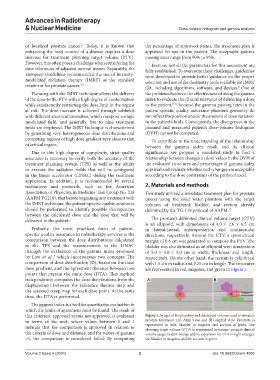
            delivered to the patient. 6                          The prostate’s delimited clinical volume target (CTV)
                                                               is  an  ellipsoid,  with  dimensions  of  4.0  ×  2.6  ×  6.5  cm
              Probably, the most  practiced form of  patient-  in lateral-lateral, anteroposterior, and craniocaudal
            specific quality assurance in radiotherapy services is the   directions, respectively. Around the CTV, a symmetrical
            comparison between the dose distributions calculated   margin of 0.6 cm was generated to compose the PTV. The
            in the TPS and the measurements in the LINAC       bladder was also delimited as an ellipsoid with dimensions
            through the evaluation of the gamma index proposed   of 5.0 × 4.0 × 5.0  cm in width, thickness, and length,
            by Low  et al.,  which incorporates two concepts: The   respectively. On the other hand, the rectum is cylindrical
                        7
            comparison of dose distribution (D), based on the local   with 1.5 cm in radius and 9.25 cm in length. The structures
            dose gradient, and the agreement distance between two   are represented in red, magenta, and green in Figure 1.
            points that present the same dose (DTA). This method
            independently compares the dose distributions from the   A                      B
            displacement between the reference fluence map and
            the assessed creep map for each dose point. At the same
            time, the DTA is performed.
              The gamma index is a tool for quantitative evaluation in
            which the limits of agreement must be found. The result of
            this criterion, approved versus not approved, is evaluated   Figure 1. Images of the phantom and delineated volumes used to simulate
            in terms of the unit, where values between 0 and  1   prostate treatment: (A) Axial view and (B) sagittal view. Prostrate is
            indicate that the comparison is approved in relation to   represented in rede, bladder in magenta and rectum in green. The
                                                               planning target volume (PTV) is represented in orange (prostate clinical
            the criteria of dose and distance, and for values of gamma   volume target in dark orange and its expansion for PTV in light orange),
            >1, the comparison is considered failed. By computing   the bladder in magenta and the rectum in green.


            Volume 2 Issue 4 (2024)                         2                              doi: 10.36922/arnm.4005

