


Page 85 - ARNM-2-4
P. 85
Advances in Radiotherapy
            & Nuclear Medicine                                               Dose-volume histogram and gamma analysis


            3.3. Rectum                                        were related to the displacements along the vertical axis.

            The comparisons of the rectums’ DVH revealed that the   Such variations presented both overdose and significant
            displacements in the longitudinal axis demonstrated the   dose decreases in critical structures. From the comparison
            greatest stability, registering values of an overdose of only   between Table 1 and the data presented in Figures 2-4, as
            0.01%, both for D  and D  when displaced 1 mm in the   a function of the displacements in the vertical axis in the
                          30
                                 10
            caudal direction, as well as maximum sub-dosage of 0.07%   DVH of organs at risk, the same correlation between the
            and 0.05% for D  and D , respectively, when displaced 3 mm   3DGI and the DVH metric was verified, and the behavior
                              10
                        30
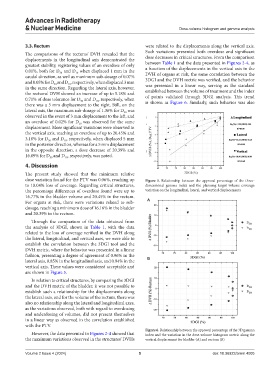
            in the same direction. Regarding the lateral axis, however,   was presented in a linear way, serving as the standard
            the rectums’ DVH showed an increase of up to 5.18% and   established between the volume of treatment and the index
            0.71% of dose tolerance for D  and D , respectively, when   of points validated through 3DGI analysis. This trend
                                   30
                                          10
            there was a 5 mm displacement to the right. Still, on the   is shown in  Figure  6. Similarly, such behavior was also
            lateral axis, the maximum sub-dosage of 1.36% for D  was
                                                      30
            observed in the event of 3 mm displacement to the left, and
            an overdose of 0.02% for D  was observed for the same
                                   10
            displacement. More significant variations were observed in
            the vertical axis, reaching an overdose of up to 20.45% and
            3.10% for D  and D , respectively, when displaced 5 mm
                            10
                      30
            in the posterior direction, whereas for a 5 mm displacement
            in the opposite direction, a dose decrease of 20.39% and
            16.09% for D  and D , respectively, was noted.
                      30
                             10
            4. Discussion
            The present study showed that the minimum relative
            dose variation found for the PTV was 0.06%, reaching up   Figure  5.  Relationship between the approval percentage of the three-
            to 10.04% loss of coverage. Regarding critical structures,   dimensional gamma index and the planning target volume coverage
            the percentage differences of overdose found were up to   variation on the longitudinal, lateral, and vertical displacements
            16.77% in the bladder volume and 20.45% in the rectum.
            For organs at risk, there were variations related to sub-  A
            dosage, reaching a minimum dose of 16.16% in the bladder
            and 20.39% in the rectum.
              Through the comparison of the data obtained from
            the  analysis  of  3DGI,  shown  in  Table  1,  with  the  data
            related to the loss of coverage verified in the DVH along
            the lateral, longitudinal, and vertical axes, we were able to
            establish the correlation between the 3DGI tool and the
            DVH metric, where the behavior was presented in a linear
            fashion, presenting a degree of agreement of 0.96% in the
            lateral axis, 0.85% in the longitudinal axis, and 0.94% in the   B
            vertical axis. These values were considered acceptable and
            are shown in Figure 5.
              In relation to critical structures, by comparing the 3DGI
            and the DVH metric of the bladder, it was not possible to
            establish such a relationship for the displacements along
            the lateral axis, and for the volume of the rectum, there was
            also no relationship along the lateral and longitudinal axes,
            as the variations observed, both with regard to overdosing
            and underdosing of volumes, did not present themselves
            in a linear way as observed in the correlation established
            with the PTV.
                                                               Figure 6. Relationship between the approval percentage of the 3D gamma
              However, the data presented in Figures 2-4 showed that   index and the variation in the dose-volume histogram metric along the
            the maximum variations observed in the structures’ DVHs   vertical displacement for bladder (A) and rectum (B)


            Volume 2 Issue 4 (2024)                         5                              doi: 10.36922/arnm.4005

