


Page 84 - ARNM-2-4
P. 84
Advances in Radiotherapy
            & Nuclear Medicine                                               Dose-volume histogram and gamma analysis


            variations of PTV coverage were along the longitudinal   posterior, with a maximum variation of 10.04% of loss
            axis, which was 0.06% in 1 mm of caudal displacement,   of coverage, in the displacement of 5  mm in anterior
            up to 3.45% when displaced 5 mm in the cranial direction   direction, as compared to the original plan.
            in relation to the original plan. Along the lateral axis, the
            minimum variation was 0.22% when shifted 1 mm to the   3.2. Bladder
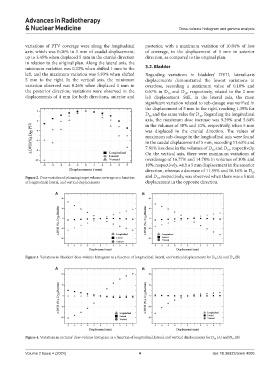
            left, and the maximum variation was 5.93% when shifted   Regarding variations in bladders’ DVH, lateral-axis
            5  mm to the right. In the vertical axis, the minimum   displacements demonstrated the lowest variations in
            variation observed was 0.26% when displaced 1  mm in   overdose, recording a maximum value of 0.10% and
            the posterior direction; variations were observed in the   0.07% in D  and D , respectively, related to the 2  mm
                                                                                10
                                                                        30
            displacements of 4 mm for both directions, anterior and   left displacement. Still, in the lateral axis, the most
                                                               significant variation related to sub-dosage was verified in
                                                               the displacement of 5 mm to the right, reaching 1.39% for
                                                               D  and the same value for D . Regarding the longitudinal
                                                                                      10
                                                                30
                                                               axis, the maximum dose increase was 9.29% and 5.64%
                                                               in the volumes of 30% and 10%, respectively, when 5 mm
                                                               was displaced in the cranial direction. The values of
                                                               maximum sub-dosage in the longitudinal axis were found
                                                               in the caudal displacement of 5 mm, recording 11.63% and
                                                               7.81% less dose in the volumes of D  and D , respectively.
                                                                                           30
                                                                                                  10
                                                               On the vertical axis, there were maximum variations of
                                                               overdosage of 16.77% and 14.70% in volumes of 30% and
                                                               10%, respectively, with a 5 mm displacement in the anterior
                                                               direction, whereas a decrease of 11.59% and 16.16% in D
                                                                                                            30
            Figure 2. Dose variation of planning target volume coverage as a function   and D , respectively, was observed when there was a 5 mm
                                                                    10
            of longitudinal, lateral, and vertical displacements  displacement in the opposite direction.

                         A                                   B


            Figure 3. Variations in bladders’ dose-volume histogram as a function of longitudinal, lateral, and vertical displacements for D 30  (A) and D 10  (B)

                         A                                   B


            Figure 4. Variations in rectums’ dose-volume histogram as a function of longitudinal, lateral, and vertical displacements for D 30  (A) and D 10  (B)


            Volume 2 Issue 4 (2024)                         4                              doi: 10.36922/arnm.4005

