


Page 58 - ARNM-3-3
P. 58
Advances in Radiotherapy
            & Nuclear Medicine                                                 LuPSMA response patterns on PSMA PET


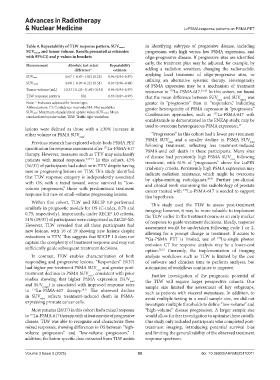
            Table 4. Repeatability of TLW response pattern, SUV max,   in identifying subtypes of progressive disease, including
            SUV mean and tumor volume. Results presented as estimates   progression with high versus low PSMA expression, and
            with 95%CI) and p-values in brackets               oligo-progressive disease. If progressive sites are identified
                                                               early, the treatment plan may be adjusted, for example, by
            Measurement       Absolute test‑retest   Repeatability
                                 difference*     estimate      adding a radiation sensitizer, changing the radionuclide,
            SUVmax           0.67 (−0.47–1.82) (0.25)  0.96 (0.94–0.97)  applying local treatment of oligo-progressive sites, or
                                                               utilizing an alternative systemic therapy. Heterogeneity
            SUVmean          0.08 (−0.07–0.22) (0.31)  0.97 (0.96–0.98)  of PSMA expression may be a mechanism of treatment
            Tumor volume (mL)  10.33 (11.02–31.69) (0.34)  0.96 (0.94–0.97)  resistance to  Lu-PSMA-617. 22-26  In this cohort, we found
                                                                         177
            TLW response pattern   NA          0.93 (0.87–0.97)  that the mean difference between SUV  and SUV mean  was
                                                                                             max
            Note: * Indicates adjusted for lesion type.        greater in “progressors” than in “responders,” indicating
            Abbreviations: CI: Confidence intervals; NA: Not available;    greater heterogeneity of PSMA expression in “progressors.”
            SUVmax: Maximum standardized uptake value; SUVmean: Mean   Combination approaches, such as   177 Lu-PSMA-617 with
            standardized uptake value; TLW: Traffic light workflow.
                                                               enzalutamide as demonstrated in the ENZAp study, may be
                                                               used to overcome heterogeneous PSMA expression. 27
            lesions were defined as those with a ≥30% increase in
            either volume or PSMA SUV .                          “Progressors” in this cohort had a lower pre-treatment
                                   max                         PSMA SUV  and a smaller decline in PSMA SUV
              Previous research has explored whole-body PSMA PET   following treatment, reflecting less treatment-induced
                                                                         max
                                                                                                           max
            quantitation for response assessment after  Lu-PSMA-617   PSMA-avid cell death in these participants. Many sites
                                             177
            therapy. However, measures such as TTV may misclassify   of disease had persistently high PSMA SUV  following
            patients with mixed responses. 5,17-19  In this cohort, 43%   treatment,  with  61%  of  “progressors”  above  the  LuPIN
                                                                                                   max
            (16/37) of participants had a decline in TTV despite having   trial entry criteria. Persistently high PSMA expression may
            new or progressing lesions on TLW. This study identified   indicate radiation resistance, which might be overcome
            that TLW response category is independently associated   by alpha-emitting radioligands. 28-31  Further pre-clinical
            with OS, with a trend toward worse survival in “low-  and clinical work examining the radiobiology of prostate
            volume progressors,” those with predominant treatment   cancer treated with  Lu-PSMA-617 is needed to support
                                                                               177
            response but new or small-volume progressing lesions.
                                                               this hypothesis.
              Within this cohort, TLW and RECIP 1.0 performed
                                                                 This study used the TLW to assess post-treatment
            similarly in prognostic models for OS (C-index, 0.70 and   imaging; however, it may be more valuable to implement
            0.75, respectively). Importantly, under RECIP 1.0 criteria,   the TLW earlier in the treatment course as an early marker
            51% (19/37) of participants were categorized as RECIP-SD.   of response to guide treatment decisions. Ideally, response
            However, TLW revealed that all these participants had   assessment would be undertaken following cycle 1 or 2,
            new lesions, with 16 of 19 showing new lesions despite   allowing for a prompt change in treatment. If access to
            reductions in TTV. This suggests that RECIP 1.0 does not   68 Ga-PSMA PET is limited, use of   177 Lu-single photon
            capture the complexity of treatment response and may not   emission CT for response analysis may be a lower-cost
            sufficiently guide subsequent treatment decisions.
                                                               option. 32,33  Currently, the implementation of imaging
              In  contrast,  TLW enables  characterization  of  both   analysis workflows such as TLW is limited by the cost
            responding and progressive lesions. “Responders” (9/37)   of software and clinician time to perform analyses, but
            had higher pre-treatment PSMA SUV  and greater post-  automation of workflows continues to improve.
                                          max
            treatment declines in PSMA SUV , consistent with prior   Further investigation of the prognostic potential of
                                       max
            studies showing that higher PSMA expression (SUV    the TLW will require larger prospective cohorts. Our
                                                        max
            and SUV mean ) is associated with improved response rates   sample size limited the assessment of key subgroups,
            to   177 Lu-PSMA-617 therapy. 20,21  The observed decline   such as patients with visceral metastases. In addition, to
            in SUV  reflects treatment-induced death in PSMA-  avoid multiple testing in a small sample size, we did not
                  max
            expressing prostate cancer cells.                  investigate multiple thresholds to define “low-volume” and
              Most patients (28/37) in this cohort had a mixed response   “high-volume” disease progression. A  larger sample size
            to  Lu-PSMA-617 therapy, with at least one site of progressive   would allow further investigation to optimize these cutoffs.
              177
            disease. TLW was able to recognize and characterize these   Our study only included participants who completed post-
            mixed responses, showing differences in OS between “high-  treatment imaging, introducing potential survival bias
            volume progressors” and “low-volume progressors.” I   and limiting the generalizability of the observed treatment
            addition, the lesion-specific data extracted from TLW assists   response spectrum.


            Volume 3 Issue 3 (2025)                         50                         doi: 10.36922/ARNM025110011

