


Page 38 - DP-1-1
P. 38
Design+                                                        Industrial design leads to understanding of users


            because it enhances the pleasure that users experience   There is a huge significance in the fashion and design
            with products by perfecting the usability, accessibility, and   industry behind the “Made in Italy” label. First, it means
            desirability generated by this interaction. The UXD process   a commitment to unparalleled expertise, skills, and
            focuses on what is designed, how the users experience a   attention to detail. Subsequently, it is a symbol of quality
            product, their connection with it, and what they expect   and excellence, strongly linked to Italy’s rich heritage of
            when thinking of it. One of the most difficult challenges   craftsmanship  traditions.  To  understand  Italian  design,
            that designers must face is the fact that every user is unique   it is necessary to investigate the past disciplines and
            and thus, can interact, and experience the same product   artistic heritage rooted in Europe because Italian design
            and situation in various ways. Due to this, designers   has taken various directions, and numerous forms have
            become pivotal in providing unforgettable user experiences   been produced by designers inspired by our past. Because
            and in understanding users and their needs, to produce an   Italian design merges creativity, originality, innovation,
            innovative and winning product design. By applying the   and the capability to adapt quickly  to the market,  it
            UXD process, users’ emotions like enjoyment or delight;   received significant acknowledgments for the label “Made
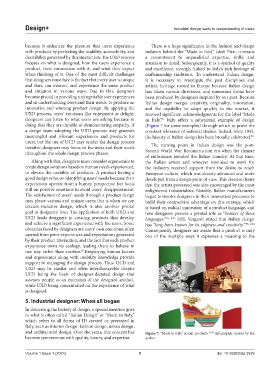
            designers can listen to what users are asking because in   in  Italy.”   Italy  offers  a  substantial  example  of  design
                                                                      51
            doing that they are capable of demonstrating empathy. If   (Figure 7 for some examples) through which to prove the
            a design team adopting the UXD process may generate   constant relevance of national studies. Indeed, since 1945,
            meaningful and relevant experiences and products for   the history of Italian design has been broadly celebrated. 52
            users, but the use of UCD may render the design process   The turning point in Italian design was the post-
            iterative, designers may focus on the users and their needs
            throughout the whole design process phases.        Second World War Reconstruction era when the climate
                                                               of enthusiasm invaded the Italian country. At that time,
              Along with that, designers must consider ergonomics to   the Italian artists and whoever intended to work for
            create design solutions based on human needs experienced,   the industry received support from the desire to reach
            to elevate the usability of products. A  product having a   European culture, which was already advanced and more
            good design relies on identifying users’ needs because their   developed from a design point of view. This creative desire
            experiences operate from a human perspective but focus   that the artists possessed was also encouraged by the most
            still on positive emotions to avoid users’ disappointment.   enlightened industrialists. Notably, Italian manufacturers
            The satisfaction of users’ needs through a product design   began to involve designers in their innovation processes to
            may please various and unique users; this is when we can   build their competitive advantage on this strategy, which
            discuss  inclusive  design,  which  is  also  another  pivotal   is based on radical innovation of a product language, and
            goal in designers’ lives. The application of both UXD and   how designers possess a pivotal role as “brokers of these
            UCD leads designers in creating products that develop   languages.” 56, p.35  Still, Verganti stated that Italian design
            and achieve a significant experience with the users. Some   has “long been known for its edginess and creativity.” 56, p.34
            obstacles faced by designers are users’ own emotions, often   Consequently, designers are aware that a product is only
            carried from prior experiences and expectations generated   one of the multiple ways it expresses a meaning to the
            by their product interaction, and the fact that each product
            experience owns its ecology, leading them to behave in
            one way rather than another.  Employing human factors
                                   50
            and ergonomics along with usability knowledge provide
            support in managing the design process. Thus, UCD and
            UXD may be similar and often interchangeable despite
            UCD being the heart of designer-dictated design that
            assesses people as an extension of the designed artefact,
            while UXD being concentrated on the experience of what
            is designed.

            5. Industrial designer: When all began
            In discussing the history of design, a special mention goes
            to what is often called “Italian Design” or “Made in Italy,”
            which refers to all forms of ID created or presented in
            Italy, such as interior design, fashion design, urban design,
            and architectural design. Over the years, this concept has   Figure 7. “Made in Italy” iconic products. 53-55  Infographic created by the
            become synonymous with quality, luxury, and expertise.  author


            Volume 1 Issue 1 (2024)                         9                                doi: 10.36922/dp.3929

