


Page 76 - DP-1-1
P. 76
Design+                                                                Defect-oriented BIST for AMS circuits


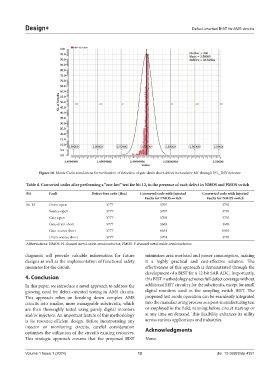
                  Figure 10. Monte Carlo simulations for verification of detection of gate-drain short defect in transistor M1 through VG _INV detector
                                                                                              1
            Table 4. Converted codes after performing a “one‑hot” test for bit 12, in the presence of each defect in NMOS and PMOS switch

            Bit       Fault             Defect‑free code (Hex)  Converted code with Injected   Converted code with Injected
                                                               Faults for PMOS switch    Faults for NMOS switch
            Bit 12    Drain-open              3777                   3707                       3701
                      Source-open             3777                   3707                       3701
                      Gate-open               3777                   3703                       3701
                      Gate-drain short        3777                   3603                       3603
                      Gate-source short       3777                   0651                       0001
                      Drain-source short      3777                   3701                       3701
            Abbreviations: NMOS: N-channel metal-oxide-semiconductor; PMOS: P-channel metal-oxide-semiconductor.

            diagnosis  will provide  valuable information for  future   minimizes area overhead and power consumption, making
            designs as well as the implementation of functional safety   it a highly practical and cost-effective solution. The
            measures for the circuit.                          effectiveness of this approach is demonstrated through the
                                                               development of a BIST for a 12-bit SAR ADC. Importantly,
            4. Conclusion                                      this BIST methodology achieves full defect coverage without
            In this paper, we introduce a novel approach to address the   additional BIST circuitry for the subcircuits, except for small
            growing need for defect-oriented testing in AMS circuits.   digital monitors used in the sampling switch BIST. The
            This  approach  relies  on  breaking  down  complex  AMS   proposed test mode operation can be seamlessly integrated
            circuits into smaller, more manageable subcircuits, which   into the manufacturing process as a post-manufacturing test
            are then thoroughly tested using purely digital monitors   or employed in the field, running before circuit start-up or
            and/or injectors. An important feature of this methodology   at any time on demand. This flexibility enhances its utility
            is its resource-efficient design. Before incorporating any   across various applications and industries.
            injector or monitoring circuits, careful consideration
            optimizes the utilization of the circuit’s existing resources.   Acknowledgments
            This strategic approach ensures that the proposed BIST   None.


            Volume 1 Issue 1 (2024)                         12                               doi: 10.36922/dp.4351

