


Page 73 - DP-1-1
P. 73
Design+                                                                Defect-oriented BIST for AMS circuits


            occurrence or different probabilities does not affect the   with a -LSB voltage at IN_N, we expect a logic high, or near
            defect coverage, as all defects are detected.      VDD value, at OUT+. However, in the Figure 8, we can
                                                               observe that the voltage at OUT+ for all the 200 cases is less
            3.1. Comparator                                    than 2 µV at OUT+, detecting the defect for all the cases.

            Table 2 lists the expected outputs of the comparator with   From the simulation results, it is clear that all defects
            different induced voltage levels given to the IN_N of   in the transistors of the pre-amplifier and the dynamic
            the comparator. Before conducting any defect coverage   latch can be detected, except for the drain-source short
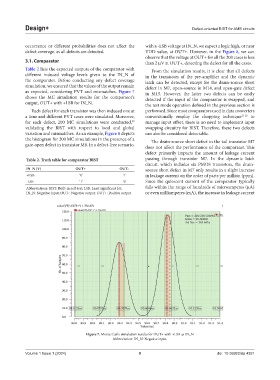
            simulation, we ensured that the values of the output remain   defect in M7, open-source in M14, and open-gate defect
            as expected, considering PVT and mismatches. Figure 7   in M15. However, the latter two defects can be easily
            shows the MC simulation results for the comparator’s   detected if the input of the comparator is swapped, and
            output, OUT+ with +LSB for IN_N.                   the test mode operation defined in the previous section is

              Each defect for each transistor was then induced one at   performed. Since most comparators used in data converters
            a time and different PVT cases were simulated. Moreover,   conventionally  employ  the  chopping  technique 23-25   to
            for each defect, 200 MC simulations were conducted,    manage input offset, there is no need to implement input
                                                         22
            validating the BIST with respect to local and global   swapping circuitry for BIST. Therefore, these two defects
            variation and mismatches. As an example, Figure 8 depicts   can also be considered detectable.
            the histogram for 200 MC simulations in the presence of a   The drain-source short defect in the tail transistor M7
            gate-open defect in transistor M6. In a defect-free scenario,   does not affect the performance of the comparator. This
                                                               defect primarily impacts the amount of leakage current
            Table 2. Truth table for comparator BIST           passing through transistor M7. In the dynamic latch
                                                               circuit, which includes six PMOS transistors, the drain-
            IN_N (V)             OUT+               OUT‑       source short defect in M7 only results in a slight increase
            +LSB                   ‘0’               ‘1’       in leakage current on the order of parts per million (ppm).
            -LSB                   ‘1’               ‘0’       Since  the  quiescent  current  of  the  comparator  typically
            Abbreviations: BIST: Built-in self-test; LSB: Least significant bit;   falls within the range of hundreds of microamperes (µA)
            IN_N: Negative input; OUT-: Negative output; OUT+: Positive output.  or even milliamperes (mA), the increase in leakage current


                                      Figure 7. Monte Carlo simulation results for OUT+ with +LSB as IN_N
                                                 Abbreviation: IN_N: Negative input.


            Volume 1 Issue 1 (2024)                         9                                doi: 10.36922/dp.4351

