


Page 70 - DP-1-1
P. 70
Design+                                                                Defect-oriented BIST for AMS circuits


            sampling switch is its relatively constant Ron with respect   2.3.2. Defect-oriented BIST for SAR ADC
            to the Vin. Having a relatively constant Ron is enabled by   As mentioned earlier, any complex AMS circuit needs to
            keeping the VGS of the main switch M1, always equal to   be broken down into smaller subcircuits. As depicted in
            VDD, independent of Vin. 18
                                                               Figure 2, we broke down the SAR ADC into a comparator,
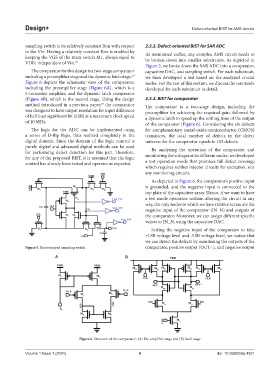
              The comparator for this design is a two-stage comparator   capacitive DAC, and sampling switch. For each subcircuit,
            including a preamplifier stage and the dynamic latch stage.    we then developed a test based on the analyzed crucial
                                                         19
            Figure  6 depicts the  schematic view of the comparator,   nodes. For the rest of this section, we discuss the test mode
            including the preamplifier stage (Figure  6A), which is a   developed for each subcircuit in detail.
            5-transistor amplifier, and the dynamic latch comparator
            (Figure 6B), which is the second stage. Using the design   2.3.3. BIST for comparator
            method introduced in a previous paper,  the comparator   The comparator is a two-stage design, including the
                                            19
            was designed to have output resolution for input difference   preamplifier for achieving the required gain, followed by
            of half least significant bit (LSB) at a maximum clock speed   a dynamic latch to speed up the settling time of the output
            of 10 MHz.                                         of the comparator (Figure 6). Considering the six defects
              The logic for the ADC can be implemented using   for  complementary  metal-oxide-semiconductor  (CMOS)
            a series  of D-flip  flops, thus realized completely  in the   transistors, the total number of defects in the defect
            digital domain. Since the domain of the logic control is   universe for the comparator equals to 102 defects.
            purely digital and advanced digital methods can be used   By analyzing the operation of the comparator and
            for performing defect detection for this part. Therefore,
            for any of the proposed BIST, it is assumed that the logic   monitoring the voltages at its different nodes, we developed
            control has already been tested and operates as expected.  a test operation mode that promises full defect coverage
                                                               which requires neither injector circuits for excitation, nor
                                                               any monitoring circuits.
                                                                 As depicted in Figure 6, the comparator’s positive input
                                                               is grounded, and the negative input is connected to  the
                                                               top plate of the capacitive array. Hence, if we want to have
                                                               a test mode operation without altering the circuit in any
                                                               way, the only nodes to which we have relative access are the
                                                               negative input of the comparator (IN_N) and outputs of
                                                               the comparator. Moreover, we can assign different specific
                                                               values to IN_N, using the capacitive DAC.
                                                                 Setting the negative input of the comparator to take
                                                               +LSB voltage level and -LSB voltage level, we notice that
                                                               we can detect the defects by monitoring the outputs of the
            Figure 5. Bootstrapped sampling switch             comparator, positive output (OUT+), and negative output

                         A                            B


                                   Figure 6. Structure of the comparator: (A) Pre-amplifier stage and (B) latch stage


            Volume 1 Issue 1 (2024)                         6                                doi: 10.36922/dp.4351

