


Page 68 - DP-1-1
P. 68
Design+                                                                Defect-oriented BIST for AMS circuits


            the International Test Conference 2020 (ITC’20).  In this   designed transition threshold voltages, were used as
                                                   15
            work, since the circuit was already quite simple, there   monitors for detecting the defects.
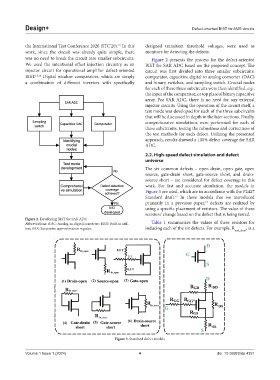
            was no need to break the circuit into smaller subcircuits.   Figure  2 presents the process for the defect-oriented
            We used the intentional offset injection circuitry as an   BIST for SAR ADC based on the proposed concept. The
            injector circuit for operational amplifier defect-oriented   circuit was first divided into three smaller subcircuits:
            BIST. 15,16  Digital window comparators, which are simply   comparator, capacitive digital to analog converter (DAC)
            a combination of different inverters with specifically   and binary switches, and sampling switch. Crucial nodes
                                                               for each of these three subcircuits were then identified, e.g.,
                                                               the input of the comparator, or top plate of binary capacitive
                                                               array. For SAR ADC, there is no need for any external
                                                               injector circuits. Using the operation of the circuit itself, a
                                                               test mode was developed for each of the three subcircuits
                                                               that will be discussed in depth in the later sections. Finally,
                                                               comprehensive simulations were performed for each of
                                                               these subcircuits, testing the robustness and correctness of
                                                               the test methods for each defect. Utilizing the presented
                                                               approach, results showed a 100% defect coverage for SAR
                                                               ADC.
                                                               2.2. High-speed defect simulation and defect
                                                               universe
                                                               The six common defects – open drain, open gate, open
                                                               source, gate-drain short, gate-source short, and drain-
                                                               source short – are considered for defect coverage in this
                                                               work. For fast and accurate simulation, the models in
                                                               Figure 3 are used, which are in accordance with the P2427
                                                               Standard draft.  In these models that we introduced
                                                                           17
                                                               primarily in a previous paper,  defects are realized by
                                                                                        13
                                                               using a specific placement of resistors. The value of these
                                                               resistors’ change based on the defect that is being tested.
            Figure 2. Developing BIST for SAR ADC
            Abbreviations: ADC: Analog-to-digital converter; BIST: Built-in self-  Table 1 summarizes the values of these resistors for
            test; SAR: Successive approximation register.      inducing each of the six defects. For example, R  , is a
                                                                                                     nml_short


                                                  Figure 3. Standard defect models


            Volume 1 Issue 1 (2024)                         4                                doi: 10.36922/dp.4351

