


Page 118 - DP-2-2
P. 118
Design+                                                          Transposing human action research to design


            to as design cues). 37,38  Here, we focused on a particular form   and it helped account for creative choices made (report on
            of analogical design prompt, which could be described as   the design process). These purposes were accomplished
            an amalgamation of formal analogies and the Indian Rule of   with visual representations of the design prompt in the
            Three. The formal analogies are of the form A is to B as C is   generalized form of the Indian Rule of Three as shown on
            to D, which is to say that the relationship between A and B   the left of Figure 1.
                                     39
            resembles that between C and D.  For example: “A fish is to   This form of the analogical prompt is applicable
            water as a bird is to air.” The Indian Rule of Three is a long-  not  only in  the  practice  of  design  but  also  in  academic
            term staple of middle school mathematics education used   design research. More specifically, among three kinds of
            to solve proportionality problems. A typical example is “If   design research distinguished by Frayling  and Findeli,
                                                                                                 20
                                                                                                            21
            6 mangoes cost 8 copper coins, how much will 15 mangoes   it is particularly applicable in research into/about design
            cost?”  or, in a generalized form,                 where it can be used to transpose existing purposeful
                 40
            A ≙ X                                              human action theory and task performance research
                                                               from non-design contexts into design contexts. This can
            B ≙ ?                                       (I)    help refute or verify, as well as differentiate or correct,
              While the  Indian Rule of Three  prompts for single,   previously established insights. In such transpositions,
            correct  solutions  of  quantitative  proportionality,  the   said analogical prompts can serve both as an operational
            form of the analogical design prompt discussed here   heuristic (enabling the identification and structuring of
            aims to stimulate divergent explorations of unexpected,   opportunities for research and theory formulation) and as
            qualitatively rich possibilities. It has the general form “If   a post facto explanatory rationale (reporting and justifying
            this kind of x is like that kind of y, then what kind of x is   motivations and frameworks of research and theoretical
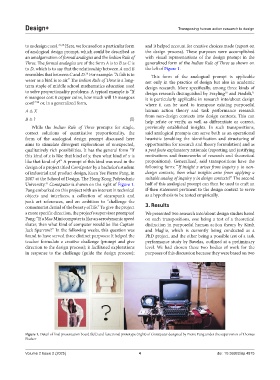
            like that kind of y?” A prompt of this kind was used in the   propositions). Generalized, said transpositions have the
            design of a project titled Com£puter by a bachelor’s student   following form: “If insight x arises from inquiry y in non-
            of industrial and product design, Kuen Yee Pierre Pang, in   design contexts, then what insights arise from applying a
            2007 at the School of Design, The Hong Kong Polytechnic   suitable analog of inquiry y in design contexts?” The second
            University.  Com£puter is shown on the right of Figure 1.   half of this analogical prompt can then be used to craft an
                    41
            Pang embarked on this project with an interest in technical   if-then statement pertinent to the design context to serve
            objects and interfaces, a collection of steampunk and   as a hypothesis to be tested empirically.
            junk art references, and an ambition to “challenge the
            consumerist denial of the beauty of life.” To give the project   3. Results
            a more specific direction, the project’s supervisor prompted   We presented two research into/about design studies based
            Pang: “If a Mac Mini computer is like an aerodynamic speed   on such transpositions, one being a test of a theoretical
            skater, then what kind of computer would be like Captain   distinction in purposeful human action theory by Kirsh
            Jack Sparrow?” In the following weeks, this question was   and Maglio, which is currently being conducted as a
            found to have served three distinct purposes: It helped the   PhD project, and the other being a possible test of a task
            teacher formulate a creative challenge (prompt and give   performance study by Bavelas, outlined at a preliminary
            direction to the design process); it facilitated explorations   level. We had chosen these two bodies of work for the
            in response to the challenge (guide the design process);   purposes of this discussion because they were based on two


            Figure 1. Detail of final presentation board (left) and functional prototype (right) of Com£puter designed by Pierre Pang under the supervision of Thomas
            Fischer


            Volume 2 Issue 2 (2025)                         4                                doi: 10.36922/dp.4875

