


Page 123 - DP-2-2
P. 123
Design+                                                          Transposing human action research to design


            a part of the overall shelving system, then we would label it   has slightly more than a reductive, descriptive value in
            a pragmatic fulfillment (“That’s good enough, let’s keep it.”)   the context of design. We argue that the six analytical
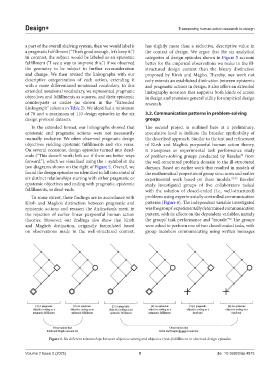
            In contrast, the subject would be labeled as an epistemic   categories of design episodes shown in Figure 5 account
            fulfillment (“I see a way to improve this.”) if we observed   better for the empirical observations we make in the ill-
            the geometry to be subject to further reconsideration   structured design context than the binary distinction
            and change. We then revised the linkographs with our   proposed by Kirsh and Maglio. Thereby, our work not
            descriptive categorization of each action, extending it   only extends an established distinction between epistemic
            with a more differentiated notational vocabulary. In this   and pragmatic actions in design; it also offers an extended
            extended notational vocabulary, we represented pragmatic   linkography notation that supports both kinds of action
            objectives and fulfillments as squares, and their epistemic   in design and promises general utility for empirical design
            counterparts as circles (as shown in the “Extended   research.
            Linkograph” column in Table 2). We identified a minimum
            of 70 and a maximum of 110 design episodes in the six   3.2. Communication patterns in problem-solving
            design protocol datasets.                          groups
              In the extended format, our linkographs showed that   The  second  project  is  outlined  here  at  a preliminary,
            epistemic and pragmatic actions were not necessarily   speculative  level  to  indicate  the  broader  applicability  of
            mutually exclusive. We often observed pragmatic design   the described approach. Similar to the test and refinement
            objectives yielding epistemic fulfillments and vice versa.   of  Kirsh  and  Maglio’s  purposeful  human  action  theory,
            On several occasions, design episodes turned into dead-  it transposes an experimental task performance study
            ends (“This doesn’t work; let’s see if there are better ways   of problem-solving groups conducted by Bavelas  from
                                                                                                       72
            forward.”), which we visualized using the + symbol in the   the well-structured problem domain to the ill-structured
            two diagrams shown on the right of Figure 5. Overall, we   domain. Based on earlier work that resulted in models of
            found the design episodes we identified to fall into a total of   the mathematical properties of group structures and earlier
            six distinct relationships starting with either pragmatic or   experimental work based on these models, 72-75  Bavelas’
            epistemic objectives and ending with pragmatic, epistemic   study investigated groups of five collaborators tasked
            fulfillments, or dead-ends.                        with the solution of closed-ended (i.e., well-structured)
              To some extent, these findings are in accordance with   problems using experimentally controlled communication
            Kirsh and Maglio’s distinction between pragmatic and   patterns (Figure 6). The independent variable investigated
            epistemic actions and reassert the distinction’s merit in   was the groups’ experimentally determined communication
            the rejection of earlier linear purposeful human action   pattern, with its effects on the dependent variables, namely
            theories. However, our findings also show that Kirsh   the groups’ task performance and “morale.”  The groups
                                                                                                  72
            and Maglio’s distinction, originally formulated based   were asked to perform one of two closed-ended tasks, with
            on observations made in the well-structured context,   group members communicating using written messages


                      Figure 5. Six different relationships between objective setting and objective (non-)fulfillment in observed design episodes


            Volume 2 Issue 2 (2025)                         9                                doi: 10.36922/dp.4875

