


Page 124 - DP-2-2
P. 124
Design+                                                          Transposing human action research to design


                                                                    77
                                                                                                         74
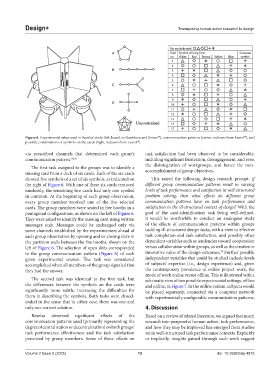
            Figure 6. Experimental setup used in Bavelas’ study (left, based on Guetzkow and Simon ), communication patterns (center, redrawn from Leavit ), and
            possible combinations of symbols on the cards (right, redrawn from Leavit )
                                                           74
            via prescribed channels that determined each group’s   task satisfaction had been observed to be considerable,
            communication pattern. 74,76                       including significant frustration, disengagement, and even
              The first task assigned to the groups was to identify a   the disintegration of workgroups, and hence the non-
            missing card from a deck of six cards. Each of the six cards   accomplishment of group objectives.
            showed five symbols of a set of six symbols, as indicated on   This raised the following design research prompt:  If
            the right of Figure 6. With one of these six cards removed   different group communication patterns result in varying
            randomly, the remaining five cards had only one symbol   levels of task performance and satisfaction in well-structured
            in common. At the beginning of each group observation,   problem  solving,  then  what  effects  do  different  group
            every group member received one of the five selected   communication patterns  have  on  task  performance  and
            cards. The group members were seated in five booths in a   satisfaction in the ill-structured context of design? With the
            pentagonal configuration, as shown on the left of Figure 6.   goal of the card-identification task being well-defined,
            They were asked to identify the missing card using written   it would be worthwhile to conduct an analogous study
            messages only.  Messages could be exchanged only via   of  the  effects  of  communication  patterns  within  groups
            some channels established by the experimenters ahead of   tackling ill-structured design tasks, with a view to effective
            each group observation by opening and or closing slots in   task completion and task satisfaction, and possibly other
            the partition walls between the five booths, shown on the   dependent variables such as tendencies toward cooperation
            left of Figure 6. The selection of open slots corresponded   versus collaboration within groups, as well as the creative or
                                                                                               78
            to the group communication pattern (Figure  6) of each   innovative value of the design outcomes.  Further possible
            given experimental session. The task was considered   independent variables that could be studied include levels
            accomplished when all members of the group signaled that   of subjects’ expertise (i.e., design experience) and, given
            they had the answer.                               the contemporary prevalence of online project work, the
                                                               mode of work online versus offline. This is illustrated with a
              The second task was identical to the first task, but   schematic view of two possible experimental settings, offline
            the  differences  between  the symbols  on the  cards  were   and online, in Figure 7. In the online variant, subjects would
            significantly more subtle, increasing the difficulties for   be  placed  separately,  connected  via  a  computer  network
            them in describing the symbols. Both tasks were closed-  with experimentally configurable communication patterns.
            ended in the sense that in either case, there was one and
            only one correct solution.                         4. Discussion
              Bavelas  observed  significant  effects  of  the  Based on a review of related literature, we argued that much
            communication patterns used (primarily representing the   research into purposeful human action, task performance,
            degree of centralization or decentralization) on both groups’   and how they may be improved has emerged from studies
            task performance effectiveness and the task satisfaction   set in well-structured task performance contexts. Explicitly
            perceived by group members. Some of these effects on   or implicitly, insights gained through such work suggest


            Volume 2 Issue 2 (2025)                         10                               doi: 10.36922/dp.4875

