


Page 122 - DP-2-2
P. 122
Design+                                                          Transposing human action research to design


                        Extended linkograph


                     Analysis phase


                        Linkograph


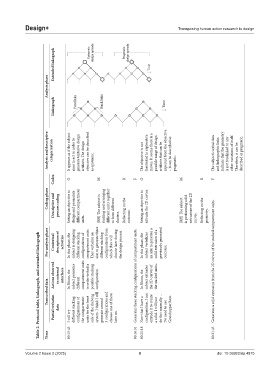
                     Analysis and descriptive   categorization  It appears as if the subject   aims to act in order to   generate tentative design   artifacts. The design   objective can be described   as epistemic.  The objective is not   forelinked to explorative   moves. It seems there is a   possible range of design   artifacts that can be  expected from the objective   – it can be described as   pragmatic.  The subject’s verbal data   and linkographic links   indicat


                        Codes  O           M          R    F  O                M       R    F


                     Coding phase  Descriptive and   process coding  Setting an objective to   design and permutate   different compartment   units.  [RH] The subject is   stacking and arranging   different units together   to form different   clusters.  Reflecting on the   outcome.  Setting an objective to   extrude the 2D curves.  [RH] The subject   is performing solid   extrusions of the 2D   curves.  Reflecting on the   geometry.


                     Pre‑analysis phase  Contextual   description of   activities  In this phase, the   subject is designing   different stacking   configurations of   compartment units.   They verbalize an   aim to generate three   different stacking   configurations from   which they will   choose later during   the design process.  In this phase, the   subject verbalizes   an aim to generate a   solid extrusion of a   previously generated   outcome.
                  Table 2. Protocol table, linkograph, and extended linkograph


                        Actions observed   in external   interfaces  In Rhino, the   subject permutes   different   compartment units   in order to find a   possible stacking   configuration.  Generates three stacking configurations of compartment units.  In Rhino, the   subject extrudes   the 2D curves of   the stacked units.  Generates a solid extrusion from the 2D curves of the stacked compartment units.


                     Transcribed data


                        Partial verbatim   data  I will try   different stacking   configurations of   the compartment   units for the front   side of the shelving   system. I think I will   generate around    3 configurations and   choose one of them   later on.  Now that I have a   configuration, I can   extrude it to create   a solid. I will just   do this manually…   No need to use   Grasshopper here.


                     Time      00:15:43                    00:16:31  00:25:18               00:31:43


            Volume 2 Issue 2 (2025)                         8                                doi: 10.36922/dp.4875

