


Page 41 - DP-2-3
P. 41
Design+                                                      Speculative and participatory stakeholder mapping


              This study aims to find and establish new connections   international non-profit organization with the mission
            between participatory and speculative design and   to benefit companies and society through IP protection.
            stakeholder identification. Across the case study discussed   However, the organization had no experience with
            in this paper, new knowledge is generated for design, both   participatory and speculative design processes. The
            as practice and discipline. Moreover, the design also served   literature reports some cases of projects where the research
            as a means to develop a method, approach, and practice for   team conducted stakeholder mapping through co-creation;
            addressing an unprecedented situation – the identification   however, the participants were invited for their background
            of  stakeholders  through  participatory  and  speculative   and expertise in stakeholder mapping and co-creation
                                                                                                            46
            design.                                            (which were both missing in the present project). The
              Building  upon  a  literature  review  on  stakeholder   development of the project followed the chronological and
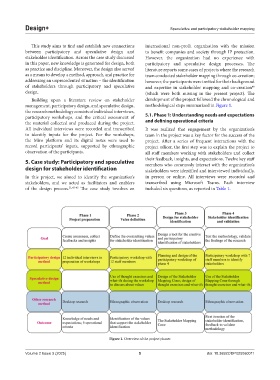
            management, participatory design, and speculative design,   methodological steps summarized in Figure 1.
            the research methodology consists of individual interviews,
            participatory workshops, and  the critical  assessment  of   5.1. Phase 1: Understanding needs and expectations
            the  material  collected  and  produced  during  the  project.   and defining operational criteria
            All individual interviews were recorded and transcribed   It was realized that engagement by the organization’s
            to identify inputs for the project. For the workshops,   team in the project was a key factor for the success of the
            the Miro platform and its digital notes were used to   project. After a series of frequent interactions with the
            record participants’ inputs, supported by ethnographic   project officer, the first step was to explain the project to
            observation of the participants.                   all staff members working with stakeholders and collect
            5. Case study: Participatory and speculative       their feedback, insights, and expectations. Twelve key staff
                                                               members who commonly interact with the organization’s
            design for stakeholder identification              stakeholders were identified and interviewed individually,
            In this project, we aimed to identify the organization’s   in person or online. All interviews were recorded and
            stakeholders, and we acted as facilitators and enablers   transcribed using Microsoft Teams. Each interview
            of the design process. 31,43-45  The case study involves an   included six questions, as reported in Table 1.


                                                Figure 1. Overview of the project phases


            Volume 2 Issue 3 (2025)                         5                            doi: 10.36922/DP025060011

