


Page 44 - DP-2-3
P. 44
Design+                                                      Speculative and participatory stakeholder mapping


            the stakeholder engagement strategy (Figure  5). During
            the prioritization process, selected stakeholders are
            moved into the cone of preferred stakeholders. This cone
            can ideally span across all other cones, with two, or even
            with only one, depending on the organization’s strategic
            decision.
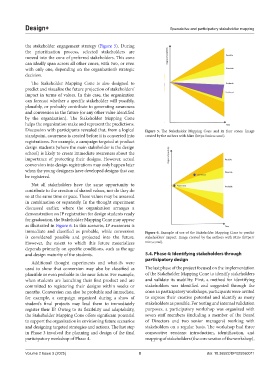
              The Stakeholder Mapping Cone is also designed to
            predict and visualize the future projection of stakeholders’
            impact in terms of values. In this case, the organization
            can forecast whether a specific stakeholder will possibly,
            plausibly, or probably contribute to generating awareness
            and conversion in the future (or any other value identified
            by the organization). The Stakeholder Mapping Cone
            helps the organization make and represent the predictions.
            Discussion with participants revealed that, from a logical   Figure  5.  The Stakeholder Mapping Cone and its four cones. Image
            standpoint, awareness is created before it is converted into   created by the authors with Miro (https://miro.com/).
            registrations. For example, a campaign targeted at product
            design students (where the main stakeholder is the design
            school) is likely to create immediate awareness about the
            importance of  protecting  their  designs.  However, actual
            conversion into design registrations may only happen later
            when the young designers have developed designs that can
            be registered.
              Not all stakeholders have the same opportunity to
            contribute to the creation of shared values, nor do they do
            so at the same time or pace. These values may be assessed
            in combination or separately. In the thought experiment
            discussed earlier, where the organization arranges a
            demonstration on IP registration for design students ready
            for graduation, the Stakeholder Mapping Cone may appear
            as illustrated in Figure 6. In this scenario, IP awareness is
            immediate and  classified  as probable, while  conversion   Figure 6. Example of use of the Stakeholder Mapping Cone to predict
            is  considered  possible  and  projected  into  the  future.   stakeholders’ impact. Image created by the authors with Miro (https://
            However, the extent to which this future materializes   miro.com/).
            depends primarily on specific conditions, such as the age
            and design maturity of the students.               5.4. Phase 4: Identifying stakeholders through
                                                               participatory design
              Additional thought experiments and what-ifs were
            used to show that conversion may also be classified as   The last phase of the project focused on the implementation
            plausible or even probable in the near future. For example,   of the Stakeholder Mapping Cone to identify stakeholders
            when students are launching their first product and are   and validate its usability. First, a method for identifying
            committed to registering their designs within weeks or   stakeholders was identified and suggested through the
            months. Conversion can also be probable and immediate,   cone: in participatory workshops, participants were invited
            for example, a campaign organized during a show of   to  express  their  creative  potential and  identify as  many
            student’s final projects may lead them to immediately   stakeholders as possible. For testing and internal validation
            register their IP. Owing to its flexibility and adaptability,   purposes, a participatory workshop was organized with
            the Stakeholder Mapping Cone offers significant potential   seven staff members (including a member of the Board
            to support the organization in envisioning future scenarios   of Directors and two senior managers) working with
            and designing targeted strategies and actions. The last step   stakeholders on a regular basis. The workshop had three
            in Phase 3 involved the planning and design of the final   consecutive sessions: introduction, identification, and
            participatory workshop of Phase 4.                 mapping of stakeholders (the core session of the workshop),


            Volume 2 Issue 3 (2025)                         8                            doi: 10.36922/DP025060011

