


Page 43 - DP-2-3
P. 43
Design+                                                      Speculative and participatory stakeholder mapping


                                                               futures (the so-called PPPP diagram): Possible, plausible,
                                                               probable, and preferable futures. We named our approach
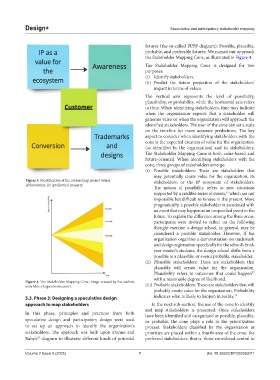
                                                               the Stakeholder Mapping Cone, as illustrated in Figure 4.
                                                               The Stakeholder Mapping Cone is designed for two
                                                               purposes:
                                                               (i)  Identify stakeholders.
                                                               (ii)  Predict the future projection of the stakeholders’
                                                                  impact in terms of values.
                                                               The vertical axis represents the level of possibility,
                                                               plausibility, or probability, while the horizontal axis refers
                                                               to time. When identifying stakeholders, time may indicate
                                                               when the organization expects that a stakeholder will
                                                               generate value or when the organization will approach the
                                                               identified stakeholders. The user of the cone can set a scale
                                                               on the timeline for more accurate predictions. The key
                                                               aspect to consider when identifying stakeholders with the
                                                               cone is the expected creation of value for the organization
                                                               (as identified by the organization) and its stakeholders.
                                                               The Stakeholder Mapping Cone is both value-based and
                                                               future-oriented. When identifying stakeholders with the
                                                               cone, three groups of stakeholders emerge:
                                                               (i)  Possible stakeholders: These are stakeholders that
                                                                  may potentially create value for the organization, its
            Figure 3. Identification of the overarching project values   stakeholders, or the IP ecosystem of stakeholders.
            Abbreviation: IP: Intellectual property.
                                                                  The notion of possibility refers to new situations
                                                                  supported by a credible series of events,  which are not
                                                                                                 37
                                                                  impossible but difficult to foresee in the present. More
                                                                  pragmatically, a possible stakeholder is associated with
                                                                  an event that may happen at an unspecified point in the
                                                                  future. To explain the difference among the three areas,
                                                                  participants were invited to reflect on the following
                                                                  thought exercise: a design school, in general, may be
                                                                  considered  a possible  stakeholder.  However, if  the
                                                                  organization organizes a demonstration on trademark
                                                                  and design registration specifically for the school’s final-
                                                                  year master’s students, the design school shifts from a
                                                                  possible to a plausible, or even a probable, stakeholder.
                                                               (ii)  Plausible stakeholders: These are stakeholders that
                                                                  plausibly will create value for the organization.
                                                                  Plausibility refers to outcomes that could happen
                                                                                                            37
                                                                  with a reasonable degree of likelihood.
            Figure 4. The Stakeholder Mapping Cone. Image created by the authors
            with Miro (https://miro.com/).                     (iii) Probable stakeholders: These are stakeholders that will
                                                                  probably create value for the organization. Probability
            5.3. Phase 3: Designing a speculative design          indicates what is likely to happen in reality. 37
            approach to map stakeholders                         In the next sub-section, the use of the cone to identify
                                                               and map stakeholders is presented. Once stakeholders
            In this phase, principles and practices from both   have been identified and categorized as possible, plausible,
            speculative design and participatory design were used   or probable, the cone plays a role in the prioritization
            to set up an approach to identify the organization’s   process. Stakeholders classified by the organization as
            stakeholders. The approach was built upon Dunne and   priorities are placed within a fourth area of the cone: the
            Raby’s  diagram to illustrate different kinds of potential   preferred stakeholders, that is, those considered central to
                 37

            Volume 2 Issue 3 (2025)                         7                            doi: 10.36922/DP025060011

