


Page 42 - DP-2-3
P. 42
Design+                                                      Speculative and participatory stakeholder mapping


              Then, the transcription of the interviews was processed   5.2. Phase 2: Prioritizing values through
            to assess the comments and topics discussed during the   participatory design
            interviews and map them in thematic clusters, as reported   The second phase of the project relied extensively on
            in Table 2.                                        participatory methods. A workshop was organized with all
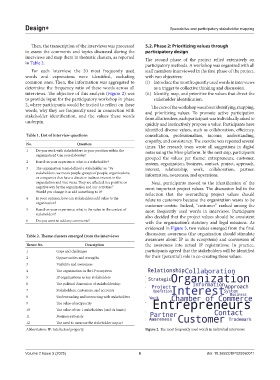
              For each interview, the 20 most frequently used   staff members interviewed in the first phase of the project,
            words and expressions were identified, excluding   with two objectives:
            common ones. Then, the information was aggregated to   (i)  Introduce the most frequently used words in interviews
            determine the frequency ratio of these words across all   as a trigger to collective thinking and discussion.
            interviews. The objective of this analysis (Figure 2) was   (ii)  Identify, map, and prioritize the values that direct the
            to provide input for the participatory workshop in phase   stakeholder identification.
            2, where participants would be invited to reflect on these   The core of the workshop was about identifying, mapping,
            words, why they are frequently used in connection with   and prioritizing values. To promote active participation
            stakeholder identification, and the values these words   from all attendees, each participant was individually asked to
            underpin.                                          quickly and instinctively propose a value. Participants have
                                                               identified diverse values, such as collaboration, efficiency,
            Table 1. List of interview questions               consultation, professionalism, income, understanding,
                                                               empathy, and consistency. The exercise was repeated several
            No.                   Question                     times. The research team wrote all suggestions in digital
            1   Do you work with stakeholders in your position within the   notes using the Miro platform. In the next step, participants
                organization? Can you elaborate?               grouped the values per theme: entrepreneurs, customer,
            2   Based on your experience, what is a stakeholder?  system, organization, business, contact, project, approach,
            3   The organization team defined a stakeholder as: “By   interest, relationship, work, collaboration, partner,
                stakeholders, we mean people, groups of people, organizations,   information, awareness, and operations.
                or companies that have a direct or indirect interest in the
                organization and vice versa. They are affected in a positive or   Next, participants moved to the identification of the
                negative way by the organization and our activities.”  most important project values. The discussion led to the
                Would you change it or add something to it?    reflection that the overarching project values should
            4   In your opinion, how can stakeholders add value to the   relate to customers because the organization wants to be
                organization?                                  customer-centric. Indeed, “customer” ranked among the
            5   Based on your experience, what is the value in the context of   most frequently used words in interviews. Participants
                stakeholders?                                  also decided that the project values should be consistent
            6   Do you want to add any comments?               with the organization’s statutory and legal missions. As
                                                               evidenced in Figure 3, two values emerged from the final
            Table 2. Theme clusters emerged from the interviews  discussion: awareness (the organization should stimulate
                                                               awareness about IP in its ecosystem) and conversion of
            Theme No.                Description               the awareness into actual IP registrations. In practice,
            1            Gaps and challenges                   participants agreed that the stakeholders will be identified
            2            Opportunities and strengths           for their (potential) role in co-creating these values.
            3            Visibility and awareness
            4            The organization in the IP ecosystem
            5            IP organizations as key stakeholders
            6            The political dimension of stakeholdership
            7            Stakeholders, customers, and accounts
            8            Understanding and interacting with stakeholders
            9            The value of reciprocity
            10           The value of tier 1 stakeholders (and its limits)
            11           Business rationale
            12           The need to measure the stakeholder impact
            Abbreviation: IP: Intellectual property.           Figure 2. The most frequently used words in individual interviews


            Volume 2 Issue 3 (2025)                         6                            doi: 10.36922/DP025060011

