


Page 96 - EER-2-1
P. 96
Explora: Environment
            and Resource                                                                    Artificial neural networks


                           Figure 1. Schematic of the experimental setup used for testing the Sony 3 Ah nickel manganese cobalt/G
                                                 Abbreviations: Ah: Ampere-hours.
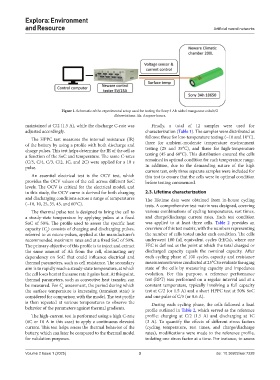
            maintained at C/2 (1.5 A), while the discharge C-rate was   Finally, a total of 12  samples were used for
            adjusted accordingly.                              characterization (Table 1). The samples were distributed as
              The HPPC test measures the internal resistance (IR)   follows: three for low-temperature testing (−10 and 10°C),
            of the battery by using a profile with both discharge and   three  for ambient-moderate temperature environment
            charge pulses. This test helps determine the IR of the cell as   testing (25 and 35°C), and three for high-temperature
            a function of the SoC and temperature. The same C-rates   testing (45 and 60°C). This distribution ensured the cells
            (C/5, C/4, C/3, C/2, 1C, and 2C) were applied for a 10 s   remained in optimal condition for each temperature range.
            pulse.                                             In addition, due to the demanding nature of the high
                                                               current test, only three separate samples were included for
              An essential electrical test is the OCV test, which   this test to ensure that the cells were in optimal condition
            provides the OCV values of the cell across different SoC   before testing commenced.
            levels. The OCV is critical for the electrical model, and
            in this study, the OCV curve is derived for both charging   2.3. Lifetime characterization
            and discharging conditions across a range of temperatures   The lifetime data were obtained from in-house cycling
            (−10, 10, 25, 35, 45, and 60°C).                   tests. A comprehensive test matrix was designed, covering

              The thermal pulse test is designed to bring the cell to   various combinations of cycling temperatures, rest times,
            a  steady-state  temperature by  applying  pulses  at  a  fixed   and charge/discharge current rates. Each test condition
            SoC of 50%. The profile used to assess the specific heat   was applied to at least three cells.  Table  2 provides an
            capacity (C ) consists of charging and discharging pulses,   overview of this test matrix, with the numbers representing
                     p
            referred to as micro-pulses, applied at the manufacturer’s   the number of cells tested under each condition. The cells
            recommended maximum rates and at a fixed SoC of 50%.   underwent 100 full equivalent cycles (FECs), where one
            The primary objective of this profile is to inject and extract   FEC is defined as the point at which the total charged or
            the same amount of Ah from the cell, eliminating any   discharged  capacity  equals the  nominal capacity. After
            dependency  on  SoC  that  could  influence  electrical  and   each cycling phase of 100 cycles, capacity and resistance
            thermal parameters, such as cell resistance. The secondary   measurements were conducted at 25°C to evaluate the aging
            aim is to rapidly reach a steady-state temperature, at which   state of the cells by measuring capacity and impedance
            the cell loses heat at the same rate it gains heat. At this point,   evolution. For this purpose, a reference performance
            thermal parameters, such as convective heat transfer, can   test (RPT) was performed on a regular interval and at a
            be measured. For C  assessment, the period during which   constant temperature, typically involving a full capacity
                            p
            the surface temperature is increasing (transient state) is   test at C/2 (or 1.5 A) and a short HPPC test at 50% SoC
            considered for comparison with the model. The test profile   and one pulse of C/5 (or 0.6 A).
            is then repeated at various temperatures to observe the   During each cycling phase, the cells followed a load
            behavior of the parameters against thermal gradients.  profile outlined in Table 2, which served as the reference
              The high-current test is performed using a high C-rate   profile:  charging  at  C/2  (1.5  A)  and  discharging  at  1C
            (6C or 18 A in this case) to apply a continuous elevated   (3 A). To quantify the effects of different stress factors
            current. This test helps assess the thermal behavior of the   (cycling temperature, rest times, and charge/discharge
            battery, which can later be compared to the thermal model   rates), modifications were made to the reference profile,
            for validation purposes.                           isolating one stress factor at a time. For instance, to assess


            Volume 2 Issue 1 (2025)                         3                                doi: 10.36922/eer.7228

