


Page 101 - EER-2-1
P. 101
Explora: Environment
            and Resource                                                                    Artificial neural networks


            (i)  The cell’s surface temperature,  T , is assumed to   experimental data. The table highlights that the model has
                                           cell
               be uniformly distributed across the entire surface,   an average error of around 2%, demonstrating the strong
               representing the overall temperature of the battery  accuracy of the electrical modeling and parameter estimation.
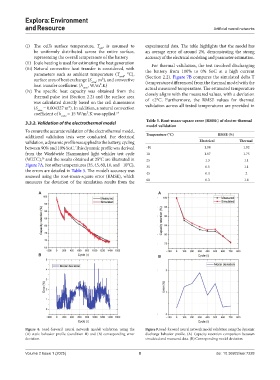
            (ii)  Joule heating is used for estimating the heat generation  For thermal validation, the test involved discharging
            (iii) Natural  convective heat transfer  is  considered, with   the battery from 100% to 0% SoC at a high current
               parameters such as ambient temperature (T , °C),   (Section 2.2). Figure 7B compares the simulated delta T
                                                    amb
               surface area of heat exchange (S , m²), and convective   (temperature differences) from the thermal model with the
                                        area
               heat transfer coefficient (h conv , W/m².K)
            (iv)  The specific heat capacity was obtained from the   actual measured temperature. The estimated temperature
                                                               closely aligns with the measured values, with a deviation
               thermal pulse test (Section 2.2) and the surface area   of <2°C. Furthermore, the RMSE values for thermal
               was calculated directly based on the cell dimensions
               (S  = 0.004327 m²). In addition, a natural convection   validation across all tested temperatures are provided in
                 area
               coefficient of h conv  = 15 W/m².K was applied. 54
                                                               Table 5. Root‑mean‑square error (RMSE) of electro‑thermal
            3.3.2. Validation of the electrothermal model
                                                               model validation
            To ensure the accurate validation of the electrothermal model,
            additional validation tests were conducted. For electrical   Temperature (°C)     RMSE (%)
            validation, a dynamic profile was applied to the battery, cycling         Electrical       Thermal
            between 90% and 10% SoC. This dynamic profile was derived   -10             1.98             1.92
            from  the  Worldwide  Harmonized  light  vehicles  test  cycle   10         1.87             1.75
            (WLTC),  and the results obtained at 25°C are illustrated in   25           1.3              1.1
                   56
            Figure 7A. For other temperatures (35, 45, 60, 10, and −10°C),   35         0.5              1.1
            the errors are detailed in Table 5. The model’s accuracy was   45           0.4              2
            assessed using the root-mean-square error (RMSE), which
            measures the deviation of the simulation results from the   60              0.3              1.6
                 A                                                  A


                 B                                                  B


            Figure  8.  Feed-forward  neural  network  model  validation  using  the   Figure 9. Feed-forward neural network model validation using the dynamic
            (A) static behavior profile (condition II) and (B) corresponding error   discharge behavior profile. (A) Capacity retention comparison between
            deviation.                                         simulated and measured data. (B) Corresponding model deviation.


            Volume 2 Issue 1 (2025)                         8                                doi: 10.36922/eer.7228

