


Page 102 - EER-2-1
P. 102
Explora: Environment
            and Resource                                                                    Artificial neural networks


            Table 5, with an average error of approximately 2%. This   unknown inputs and long-term cycling data. 28,55,57  In
            confirms the reliability of the thermal model, which uses   this study, both static and dynamic profiles were used to
            only Joule heating to predict temperature changes.  validate our lifetime model.
              In summary, the electrothermal model accurately   3.4.1. Static profile validation
            captures the electrical and thermal performance of the
            Sony 3 Ah cell under dynamic load conditions, making it   For the static profile validation, an independent dataset not
            a reliable tool for optimization algorithm development.  included in the ANN training process was employed. These
                                                               data were obtained from condition II (25°C; 1C discharge/0.5C
            3.4. Lifetime model                                charge, 100% depth of discharge [DoD]; Table 2).
            The validation of an aging model typically involves   Figure 8A presents a comparison between the measured
            comparing its lifetime predictions against a set of previously   and simulated capacity retention over 1400 FECs. An

                         A                                   B


                         C                                   D


                         E                                    F


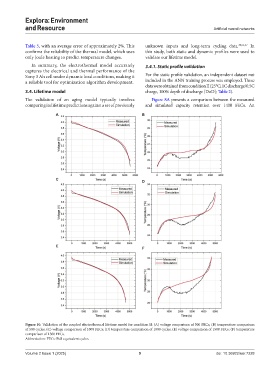
            Figure 10. Validation of the coupled electrothermal lifetime model for condition II: (A) voltage comparison of 500 FECs; (B) temperature comparison
            of 500 cycles; (C) voltage comparison of 1000 FECs; (D) temperature comparison of 1000 cycles; (E) voltage comparison of 1500 FECs; (F) temperature
            comparison of 1500 FECs.
            Abbreviation: FECs: Full equivalent cycles.


            Volume 2 Issue 1 (2025)                         9                                doi: 10.36922/eer.7228

