


Page 21 - EER-2-3
P. 21
Explora: Environment
            and Resource                                                         Environmental contamination of titanium


            the accumulation rate of Ti in the environment and
            mitigate associated environmental risks. 148
              The  National  Institute  for  Occupational  Safety and
            Health (NIOSH) classifies TiO as a potential occupational
                                    2
            carcinogen. However, in response to growing concerns over
            TiO NPs’toxicity and the evidence of TiO carcinogenic
               2
                                               2
            qualities in animal studies revealed by IARC, France has
            started a classification process under European Regulation
            (EC) No.1272/2008. 118,149  According to the Toxic
            Enforcement and Safe Drinking Water Act administered
            by the Office of Environmental Health Hazard Assessment
            of the California Environmental Protection Agency, the list
            of chemicals known to cause cancer, created in 1986 under
            Proposition 65, was revised on September 2, 2011. 118,150
            This list was expanded to include respirable TiO  airborne
                                                  2
            particles.   The US  Food  and Drug  Administration  has
                   151
            allowed TiO  as a food additive as long as its content is less
                      2
            than 1% of the food’s weight. Similarly, as long as acceptable
            manufacturing procedures are adhered to, the EFSA also
            permits TiO  as a food additive with no maximum limit.
                                                         33
                      2
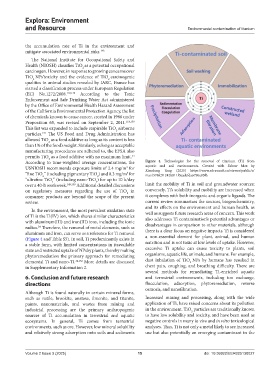
            According  to  time-weighted  average  concentrations,  the   Figure  4. Technologies for the removal of titanium (Ti) from
                                                       3
            USNIOSH recommends exposure limits of 2.4 mg/m  for   aquatic and soil environments. Created with Edraw Max by
                                                               Xiaodong Yang (2025) https://www.edrawsoft.cn/viewer/public/s/
            “fine TiO ” (including pigmentary TiO ) and 0.3 mg/m  for   max/578fc91242b811f0aadcfda6796e95fb.
                                                       3
                                          2
                   2
            “ultrafine TiO ” (including nano-TiO ) for up to 10 h/day
                       2
                                          2
            over a 40-h workweek. 149,150  Additional detailed discussions   limit the mobility of Ti in soil and groundwater sources;
            on regulatory measures regarding the use of TiO  in   conversely, Ti’s solubility and mobility are increased when
                                                       2
            consumer products are beyond the scope of the present   it complexes with both inorganic and organic ligands. The
            review.                                            current review summarizes the sources, biogeochemistry,
                                                               and its effects on the environment and human health, as
              In the environment, the most prevalent oxidation state   well as suggests future research areas of concern. This work
            of Ti is the Ti(IV) ion, which shares similar characteristics   also addresses Ti contamination’s potential advantages or
            with aluminum(III) and iron(III) ions, including the ionic   disadvantages in comparison to other materials, although
            radius.  Therefore, the removal of metal elements, such as
                 24
            aluminum and iron, can serve as a reference for Ti removal   there is a clear focus on negative impacts. Ti is considered
            (Figure 4 and Table S5). In soil, Ti predominantly exists in   a non-essential element for plant, animal, and human
            a stable form, with limited concentrations in itsavailable   nutrition and is not toxic at low levels of uptake. However,
            state and restricted uptake of NPsby plants, thereby making   excessive Ti uptake can cause toxicity to plants, soil
            phytoremediation the primary approach for remediating   organisms, aquatic life, animals, and humans. For example,
            elemental Ti and nano-Ti. 34,152  More details are discussed   dust inhalation of TiO NPs by humans has resulted in
                                                                                  2
            in Supplementary Information 2.                    chest pain, coughing, and breathing difficulty. There are
                                                               several  methods  for  remediating  Ti-enriched  aquatic
            6. Conclusion and future research                  and terrestrial environments, including ion exchange,
            directions                                         flocculation, adsorption, phytoremediation, reverse
                                                               osmosis, and nanofiltration.
            Although Ti is found naturally in certain mineral forms,
            such as rutile, brookite, anatase, ilmenite, and titanite,   Increased mining and processing, along with the wide
            paints, nanomaterials, and wastes from mining and   application of Ti, have raised concerns about its pollution
            industrial processing are the primary anthropogenic   in the environment. TiO  particles are traditionally known
                                                                                  2
            sources of Ti accumulation in terrestrial and aquatic   to have low solubility and toxicity, and have been used as
            ecosystems. In general, Ti comes from terrestrial   negative controls in many in vivo and in vitro toxicological
            environments, such as ore. However, low mineral solubility   analyses. Thus, Ti is not only a metal likely to see increased
            and relatively strong adsorption onto soils and sediments   use but also potentially an emerging contaminant in the


            Volume 2 Issue 3 (2025)                         15                          doi: 10.36922/EER025130027

