


Page 61 - EER-2-3
P. 61
Explora: Environment
            and Resource                                                     Electrocatalyst for ammonia oxidation reaction


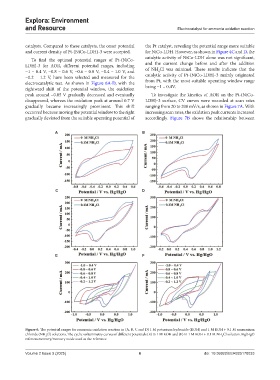
            catalysts. Compared to these catalysts, the onset potential   the Pt catalyst, revealing the potential range more suitable
            and current density of Pt-(NiCo-LDH)-3 were accepted.  for NiCo-LDH. However, as shown in Figure 4C and D, the
              To find the optimal potential ranges of Pt-(NiCo-  catalytic activity of NiCo-LDH alone was not significant,
            LDH)-3 for AOR, different potential ranges, including   and  the  current  change  before  and  after  the  addition
            −1 – 0.4 V, −0.8 – 0.6 V, −0.6 – 0.8 V, −0.4 – 1.0 V, and   of NH Cl was minimal. These results indicate that the
                                                                    4
            −0.2 – 1.2 V, have been selected and measured for the   catalytic activity of Pt-(NiCo-LDH)-3 mainly originated
            electrocatalytic test. As shown in  Figure  6A-D, with the   from Pt, with the most suitable operating window range
            rightward shift of the potential window, the oxidation   being −1 – 0.4V.
            peak around −0.05 V gradually decreased and eventually   To investigate the kinetics of AOR on the Pt-(NiCo-
            disappeared, whereas the oxidation peak at around 0.7 V   LDH)-3 surface, CV curves were recorded at scan rates
            gradually became increasingly prominent. This shift   ranging from 20 to 200 mV/s, as shown in Figure 7A. With
            occurred because moving the potential window to the right   increasing scan rates, the oxidation peak currents increased
            gradually deviated from the suitable operating potential of   accordingly.  Figure  7B shows the relationship between


                        A                                    B


                         C                                   D


                         E                                    F


            Figure 6. The potential ranges for ammonia oxidation reaction in (A, B, C and D) 1 M potassium hydroxide (KOH) and 1 M KOH + 0.1 M ammonium
            chloride (NH Cl) solutions. The cyclic voltammetry curves of different potentials (E) in 1 M KOH and (F) in 1 M KOH + 0.1 M NH Cl solution. Hg/HgO
                                                                                               4
                    4
            refers to mercury/mercury oxide used as the reference.
            Volume 2 Issue 3 (2025)                         6                           doi: 10.36922/EER025170033

