


Page 62 - EER-2-3
P. 62
Explora: Environment
            and Resource                                                     Electrocatalyst for ammonia oxidation reaction


            Table 1. The ammonia oxidation reaction test conditions and activity of reported catalysts
            Electrode            Onset potential (V)  Current density (mA/cm )  Electrolyte  Stability  References
                                                                2
            Platinum/cobalt–iron/nickel   −0.019 V RHE  50.00 at 0.029 V RHE  0.2 M N H  1.0 M KOH  At −0.017 V RHE  for   23
                                                                          +
                                                                        2
                                                                          4
            foam                                                                      100 h
            Platinum–iridium–copper  0.350 V      40.60 at 0.500 V  0.1 M NH  1.0 M KOH  At 0.650 V   for   24
                                                                          +
                                         RHE                 RHE         3                   RHE
                                                                                      500 s
            Silver/iron (II) oxide/titanate   −0.500 V Ag/AgCl  -  0.1 M NH4Cl  1.0 M   At −0.250 V Ag/AgCl  for   25
                                                                           +
            nanotubes                                              phosphate-buffered saline  five cycles
                                                                           +
            Platinum–cobalt hydroxide–  0.250 V RHE  10.17 at − 0.200 V RHE  0.1 M NH4Cl  1.0 M KOH  -  31
            nickel foam-3
                                                                           +
            Nickel–copper–sulfur treated/  1.374 V RHE  110.00 at 1.690 V RHE  0.2 M NH4Cl  1.0 M NaOH  At 1.640 V RHE  for   27
            carbon paper                                                              24 h
            Platinum–iridium        0.350 V RHE   32.20 at 0.500 V RHE  1.0 M ammonia  1.0 M KOH  At 0.500–1.000 V RHE    28
                                                                            +
            (5:5 atomic ratio)/XC-72                                                  for 4,000 cycles
            Platinum–(nickel–cobalt   −0.03 V Hg/HgO  154.60 at 0.24 V Hg/HgO  0.1 M NH Cl  1.0 M KOH  At 0.24 VHg/HgO for   This work
                                                                           +
                                                                         4
            layered double hydroxide)-3                                               5,000 s
            Abbreviations: Ag: Silver; AgCl: Silver chloride; Hg: Mercury; HgO: Mercury oxide; KOH: Potassium chloride; NH Cl: Ammonium chloride;
                                                                                     4
            RHE: Reversible hydrogen electrode.
                        A                                    B


                         C                                   D


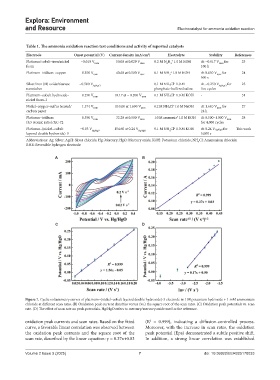
            Figure 7. Cyclic voltammetry curves of platinum–(nickel–cobalt layered double hydroxide)-3 electrode in 1 M potassium hydroxide + 1 mM ammonium
            chloride at different scan rates. (B) Oxidation peak current densities versus (vs.) the square root of the scan rates. (C) Oxidation peak potentials vs. scan
            rate. (D) The effect of scan rate on peak potentials. Hg/HgO refers to mercury/mercury oxide used as the reference.


            oxidation peak currents and scan rates. Based on the fitted   (R  = 0.999), indicating a diffusion-controlled process.
                                                                 2
            curve, a favorable linear correlation was observed between   Moreover,  with  the increase  in scan rates, the  oxidation
            the oxidation peak currents and the square root of the   peak potential (Epa) demonstrated a subtle positive shift.
            scan rate, described by the linear equation: y = 0.37x+0.03   In addition, a strong linear correlation was established


            Volume 2 Issue 3 (2025)                         7                           doi: 10.36922/EER025170033

