


Page 64 - EER-2-3
P. 64
Explora: Environment
            and Resource                                                     Electrocatalyst for ammonia oxidation reaction


              Three analyses, SEM, X-ray diffraction (XRD, D8   LDH)-3 showed more apparent changes, indicating that
            advance, Bruker, Germany), and XPS, were employed   the NiCo-LDH underwent phase transitions and lattice
            to study the morphology and composition of Pt-(NiCo-  rearrangements during the electrochemical measurement
            LDH)-3.  Figure  9A and  B show the SEM images of   process.
            NiCo-LDH.  It was observed that  NiCo-LDH  existed   Figure  10 exhibits the XRD pattern of Pt-(NiCo-
            in the form of nanowires, with a certain degree of   LDH)-3. As shown in Figure 7, the three strong diffraction
            agglomeration. At  a lower magnification  (Figure  9B),   peaks at 44.7°, 52.0°, and 76.5° could be attributed to NF.
            it was easy to observe that these nanowires combined   In addition, three diffraction peaks could be detected at
            to form a flower-like morphology. However, after the   40.5°, 47.1°, and 68.7°, attributable to the 111, 200, and 220
            growth  of  Pt  after  incubation  in  the  water  bath,  the   crystal planes of Pt.  In addition, a weaker diffraction peak
                                                                              30
            flower-like structure formed by the agglomeration of   of NiCo-LDH was observed at 22.8°.  The XRD diffraction
                                                                                            24
            these NiCo-LDH nanowires degraded, as shown in     peaks of NiCo-LDH and Pt confirm the successful growth
            Figure 9C and D. This could be attributed to two aspects:
            first, the addition of H PtCl  6H O introduces a large   of NiCo-LDH and Pt on the surface of NF.
                                        2
                                    6
                                2
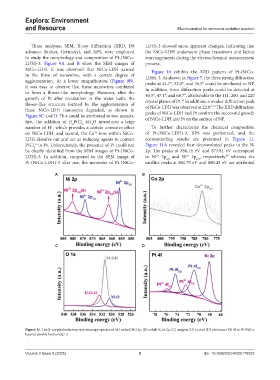
            number of H , which provides a certain corrosive effect   To further characterize the chemical composition
                       +
            on NiCo-LDH, and second, the Co  ions within NiCo-  of Pt-(NiCo-LDH)-3, XPS was performed, and the
                                         3+
            LDH dissolve out and act as reducing agents to convert   corresponding results are presented in  Figure  11.
                2-
            PtCl to Pt. Unfortunately, the presence of Pt could not   Figure  11A revealed four deconvoluted peaks in the Ni
               6
            be clearly identified from the SEM images of Pt-(NiCo-  2p. The peaks at 856.14 eV and 873.81 eV correspond
            LDH)-3. In addition, compared to the SEM image of   to Ni  2p  and Ni  2p , respectively,  whereas the
                                                                   2+
                                                                                2+
                                                                                                 30
                                                                        3/2
                                                                                    1/2
            Pt-(NiCo-LDH)-3 after use, the nanowire of Pt-(NiCo-  satellite peaks at 861.73 eV and 880.43 eV are attributed
                        A                                    B


                         C                                   D


            Figure 11. The X-ray photoelectron spectroscopy spectra of (A) nickel (Ni) 2p, (B) cobalt (Co) 2p, (C) oxygen (O) 1s, and (D) platinum (Pt) 4f in Pt-(NiCo
            layered double hydroxide)-3


            Volume 2 Issue 3 (2025)                         9                           doi: 10.36922/EER025170033

